Thursday, 17 Sep, 2026

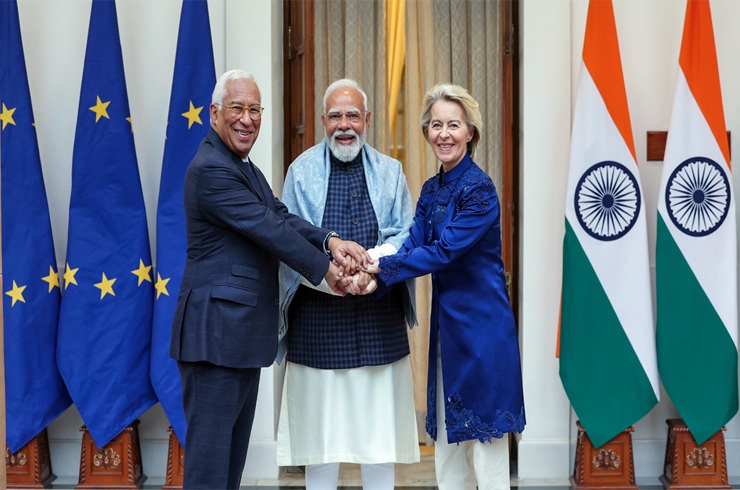
The India–EU FTA goes beyond conventional trade liberalisation and reflects the evolving nature of global commerce. Image Source: DD
With a combined economic size estimated at over INR 2091.6 lakh crore (approximately USD 24 trillion), the India–EU FTA creates unprecedented opportunities for nearly two billion people across both regions.
India and the European Union (EU) have announced the successful conclusion of negotiations for a Free Trade Agreement (FTA), marking a major milestone in one of India’s most strategically important economic partnerships. Conceived as a modern, rules-based trade arrangement, the FTA is designed to address contemporary global economic challenges while fostering deeper and more resilient market integration between the world’s fourth- and second-largest economies.
Economic scale and strategic relevance
With a combined economic size estimated at over INR 2091.6 lakh crore (approximately USD 24 trillion), the India–EU FTA creates unprecedented opportunities for nearly two billion people across both regions. Together, India and the EU account for nearly 25 percent of global GDP and about one-third of global trade. The integration of two large, diverse, and complementary economies is expected to generate substantial gains in trade, investment, innovation, and supply-chain resilience.
The agreement delivers exceptional market access for Indian exporters, covering more than 99 percent of India’s exports by trade value. At the same time, it preserves adequate policy space for sensitive sectors, ensuring alignment with India’s developmental priorities and domestic economic objectives.
Trends in bilateral trade
India–EU trade relations have shown consistent growth in recent years. Bilateral merchandise trade was valued at around INR 11.5 lakh crore (USD 136.54 billion) in 2024–25, with Indian exports accounting for approximately INR 6.4 lakh crore (USD 75.85 billion). Trade in services between the two partners reached nearly INR 7.2 lakh crore (USD 83.10 billion) during the same period, underscoring the growing importance of services in the overall economic relationship.

Source: European Comission
The FTA is expected to further scale up these flows, positioning India and the EU as major economic partners for each other in an increasingly uncertain global environment.
Scope and structure of the agreement
The India–EU FTA goes beyond conventional trade liberalisation and reflects the evolving nature of global commerce. It covers traditional areas such as trade in goods and services, rules of origin, trade remedies, customs procedures, and trade facilitation. In addition, it incorporates emerging and forward-looking areas including digital trade, support for small and medium-sized enterprises (SMEs), and regulatory cooperation.
The agreement provides a stable and predictable framework for exporters and investors, enabling Indian businesses, particularly MSMEs, to plan long-term investments, integrate into European value chains, and maintain reliable market access despite global economic volatility.
Boost to labour-intensive and manufacturing sectors
A key outcome of the FTA is the significant boost it provides to India’s labour-intensive sectors. Industries such as textiles, apparel, leather, footwear, marine products, gems and jewellery, handicrafts, engineering goods, and automobiles are set to benefit from tariff reductions of up to 10 percent, with duties on nearly USD 33 billion worth of exports eliminated upon the agreement’s entry into force.
These measures are expected to enhance India’s export competitiveness while generating employment and empowering workers, artisans, women, youth, and MSMEs. By facilitating deeper integration into global value chains, the FTA reinforces India’s role as a reliable supplier in international markets.
Automobiles and industrial cooperation
In the automobile sector, the agreement introduces a carefully calibrated, quota-based liberalisation framework. This approach allows European manufacturers to introduce high-end models in the Indian market while safeguarding domestic interests. At the same time, it opens up future possibilities for manufacturing under the Make in India initiative and for exporting India-made vehicles to the EU.
Indian consumers are likely to benefit from access to advanced technologies and increased competition, while reciprocal market access creates new opportunities for Indian automobile manufacturers in the European market.
Agriculture and processed food exports
The FTA is expected to provide a significant uplift to India’s agricultural and processed food sectors by creating a more level playing field for Indian farmers and agribusinesses. Products such as tea, coffee, spices, fresh fruits and vegetables, and processed foods will gain enhanced market access and competitiveness in the EU.
These provisions are likely to strengthen rural livelihoods, support inclusive growth, and reinforce India’s reputation as a dependable global supplier of agricultural products. At the same time, India has safeguarded sensitive sectors, including dairy, cereals, poultry, soymeal, and select fruits and vegetables, ensuring a balance between export promotion and domestic food security concerns.
Addressing non-tariff barriers and regulatory issues
Beyond tariff liberalisation, the agreement places strong emphasis on addressing non-tariff barriers. It includes provisions for enhanced regulatory cooperation, improved transparency, streamlined customs procedures, and strengthened disciplines related to Sanitary and Phytosanitary (SPS) measures and Technical Barriers to Trade.
These measures are expected to reduce compliance costs, facilitate smoother market entry, and improve predictability for businesses operating across both markets.
Climate, CBAM, and sustainability cooperation
In the context of the EU’s Carbon Border Adjustment Mechanism (CBAM), the FTA secures important commitments for India. These include forward-looking most-favoured nation assurances, extending flexibilities granted to third countries, enhanced technical cooperation on the recognition of carbon pricing systems and verifiers, and access to financial assistance and targeted support.
Such provisions aim to help Indian exporters reduce greenhouse gas emissions and comply with emerging carbon-related requirements, while maintaining competitiveness in the EU market.
Services trade and mobility
Services, which represent a dominant and fast-growing segment of both economies, are expected to see substantial gains under the FTA. Greater certainty of market access, non-discriminatory treatment, facilitation of digitally delivered services, and improved mobility frameworks are set to boost India’s services exports.
The EU has committed to expanded and commercially meaningful access across 144 subsectors of interest to India, including IT and IT-enabled services, professional services, education, and other business services. In return, India has offered access in 102 subsectors, facilitating the inflow of high-technology services and investments from the EU in a mutually beneficial arrangement.
On mobility, the agreement establishes a predictable and facilitative framework for business travel and temporary movement of professionals. Commitments cover Intra-Corporate Transferees and Business Visitors, along with entry and working rights for their dependents. The EU has also extended commitments for Contractual Service Suppliers and Independent Professionals across a wide range of sectors relevant to India. Additionally, the FTA creates a framework for engagement on social security agreements over a five-year period and supports student mobility and post-study work opportunities.
Future-oriented cooperation and strategic outlook
The FTA also lays the foundation for cooperation in critical and emerging areas such as artificial intelligence, clean technologies, and semiconductors, supporting India’s long-term technological and industrial advancement.
Overall, the India–EU FTA marks the beginning of a new phase in bilateral economic engagement. It strengthens trade and strategic cooperation between India and the 27-member EU bloc, while embedding review and consultation mechanisms to address future challenges arising from evolving technologies, regulatory complexities, and global economic shifts. The agreement rests on mutual trust and strong institutional stewardship to ensure durable and shared gains.
With this agreement, the EU becomes India’s 22nd FTA partner. Since 2014, India has concluded trade agreements with Mauritius, the UAE, Australia, EFTA, Oman, and the UK, and has announced the conclusion of negotiations with New Zealand. The India–EU FTA thus fits into India’s broader strategy of deepening economic integration with key global partners while safeguarding national interests.