Thursday, 17 Sep, 2026

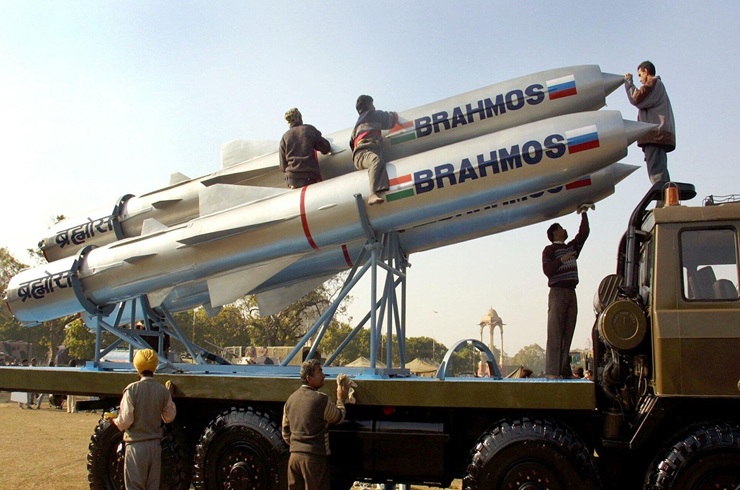
The advanced facility, an integral part of the UP Defence Industrial Corridor, had been virtually inaugurated by the Raksha Mantri on May 11, 2025, and in just five months, it successfully produced the first set of missiles ready for operational deployment. Image Source: Sputnik India
Once the deal is completed, Indonesia will become the second foreign customer of the BrahMos missile, following the Philippines, which signed a contract with India in 2022.
Indonesia is preparing to acquire the BrahMos supersonic cruise missile system from India as part of its efforts to strengthen coastal defence capabilities. Officials in India’s Ministry of Defence indicated that the agreement between the two countries has already been finalized, and a formal contract is likely to be signed within the next few months. Once the deal is completed, Indonesia will become the second foreign customer of the BrahMos missile, following the Philippines, which signed a contract with India in 2022.
The Philippines purchased the system to enhance its maritime security and coastal defence posture as part of a broader military modernization initiative. BrahMos missiles have an operational range of about 290 kilometers and can be launched from multiple platforms, including land-based launchers, naval vessels, submarines, and aircraft. This versatility allows the system to be used in a wide range of operational environments and mission profiles.
The BrahMos missile itself is the result of a joint venture between India and Russia. It was jointly developed by India’s Defence Research and Development Organisation (DRDO) and Russia’s NPO Mashinostroyenia (NPOM), and it is produced by BrahMos Aerospace. The system has become one of the most important components of India’s precision strike capability and has been inducted into service with both the Indian Army and the Indian Navy. During Operation Sindoor, the missile was reportedly used to target Pakistani air bases and other military installations, demonstrating its effectiveness in operational scenarios.
Technically, BrahMos is a long-range supersonic cruise missile designed to travel at speeds significantly faster than conventional subsonic cruise missiles. Unlike ballistic missiles that follow a high-arcing trajectory, BrahMos flies primarily within the atmosphere and relies on aerodynamic lift for most of its flight. It is launched using a solid-fuel booster that accelerates the missile to supersonic speed. After this initial phase, a ramjet-powered cruise stage sustains the missile’s high velocity during the remainder of its flight. Its high speed, combined with the ability to fly at very low altitudes over the sea in a “sea-skimming” profile, significantly reduces the time available for enemy radar detection and defensive response. This makes interception extremely difficult. In addition, the missile can follow flexible and complex flight paths, allowing it to evade defensive systems and approach targets from unexpected directions.
The missile’s guidance system integrates inertial navigation with satellite-based updates during mid-course flight, ensuring accurate positioning throughout its trajectory. In the terminal phase, an advanced seeker guides the missile precisely onto its target, whether it is a stationary land installation or a moving naval vessel. BrahMos can be equipped with different types of warheads depending on mission requirements, including blast-fragmentation warheads designed to damage surface targets and penetration warheads capable of striking fortified structures.
Another key feature of the system is its adaptability across multiple launch platforms. Land-based versions are typically mounted on road-mobile transporter-erector-launchers (TELs), which allow rapid deployment and mobility. Naval variants are integrated into vertical launch systems on ships and submarines, while the air-launched version is carried by fighter aircraft. This multi-platform deployment capability provides armed forces with significant operational flexibility.
The combination of supersonic speed, precision targeting, and platform versatility makes BrahMos one of the most formidable tactical strike systems currently available. It can be used effectively in both maritime and land warfare scenarios, offering a powerful deterrent capability and the ability to conduct rapid precision strikes against high-value targets. India’s efforts to export the BrahMos missile also align with a broader strategy to strengthen its domestic defence manufacturing sector and expand its presence in the global defence market. The Indian government has been pursuing policies aimed at increasing self-reliance in military production while simultaneously promoting defence exports to friendly countries.
In line with these goals, India recently updated its Defence Procurement Manual, a key policy document that governs the revenue procurement process within the Ministry of Defence. The revised framework is intended to streamline procurement procedures, improve coordination among the Army, Navy, and Air Force, and enable faster decision-making. By modernizing the procurement system, the government aims to ensure that the armed forces can quickly acquire essential equipment while maintaining a high level of operational readiness.
India’s defence production has recorded a major milestone, reaching an all-time high of Rs 1.54 lakh crore in FY 2024–25. This represents an 18 percent increase over the previous year’s output of Rs 1.27 lakh crore and nearly a 90 percent rise compared to FY 2019–20, when production stood at Rs 79,071 crore. Defence Public Sector Undertakings and other public sector entities accounted for about 77 percent of this production, while the private sector contributed the remaining 23 percent. The gradual rise in the private sector’s share, from 21 percent in FY 2023–24 to 23 percent in FY 2024–25, highlights its expanding role within the country’s defence industrial ecosystem. In line with this growth trajectory, the Government has set an ambitious target of scaling defence manufacturing output to Rs 3 lakh crore by 2029.
India’s Defence production

Source: Department of Defence Production, Ministry of Defence
The Union Budget for FY 2026–27, presented in the immediate aftermath of Operation Sindoor, marks a decisive inflection point in India’s defence planning and resource prioritisation. With an allocation of Rs 7.85 lakh crore, the defence budget has reached an unprecedented scale, reflecting the government’s assessment of a more contested and unpredictable security environment. This allocation amounts to nearly 2 percent of the estimated GDP for the forthcoming financial year and represents a substantial 15.19 percent increase over the Budget Estimates of FY 2025–26. At 14.67 percent of total Central Government expenditure, defence once again commands the largest share among all ministries, underscoring its centrality in national policy at a time of heightened geopolitical uncertainty.

Source: Union Budget Documents
A defining feature of the FY 2026–27 budget is the sharp rise in capital expenditure, which has been increased to Rs 2.19 lakh crore from Rs 1.80 lakh crore in FY 2025–26, amounting to a growth of 21.84 percent. This expansion reflects a strategic recognition that force modernisation can no longer proceed at a gradual pace, given the rapid evolution of military technologies and the increasingly blurred distinction between peace, crisis, and conflict.
On October 17, 2025, the Raksha Mantri inaugurated the third production line for the Light Combat Aircraft Tejas Mk1A and the second production line for the Hindustan Turbo Trainer-40 at Hindustan Aeronautics Limited’s Nashik facility, and also flagged off the first Tejas Mk1A manufactured there. The third LCA Mk1A production line was operationalised by HAL in a record time of two years and is equipped with more than 30 structure assembly jigs covering all major aircraft modules, including the centre, front and rear fuselage, wings and air intake. This fully functional line has the capacity to produce eight aircraft annually, and with its commissioning, HAL’s total LCA production capacity has increased to 24 aircraft per year.
Further strengthening defence capabilities, the Defence Acquisition Council on December 29, 2025, cleared capital acquisition proposals worth around Rs 79,000 crore. These approvals cover a wide range of systems, including loiter munition systems for artillery regiments, low-level lightweight radars, long-range guided rocket ammunition for the Pinaka multiple launch rocket system, and integrated drone detection and interdiction systems for the Indian Army. For the Indian Navy, approvals included bollard pull tugs, high-frequency software-defined radios in manpack configuration, and leasing of high-altitude long-range remotely piloted aircraft systems. The Indian Air Force will benefit from procurements such as automatic take-off and landing recording systems, Astra Mk-II missiles, full mission simulators, and SPICE-1000 long-range guidance kits.
On May 11, 2025, the Raksha Mantri virtually inaugurated the BrahMos Integration and Testing Facility in Lucknow, a significant component of the Uttar Pradesh Defence Industrial Corridor. Within just five months of its inauguration, the first batch of missiles produced at the facility was flagged off. The centre is equipped to carry out the complete process of assembly, integration and testing of BrahMos missiles, adhering to the highest technical and quality standards, and represents a major step forward in strengthening domestic missile manufacturing capabilities.
Defence exports also registered a new high in FY 2025-26, reaching Rs 29,878 crore. In FY 2025-26, the private sector contributed Rs 16,286 crore to defence exports, while Defence Public Sector Undertakings accounted for Rs 13,591 crore, compared to contributions of Rs 15,209 crore and Rs 5,874 crore respectively in the previous year. Building on this upward trend, the Government has set an ambitious defence exports target of Rs 50,000 crore by 2029, reinforcing India’s growing stature as a reliable exporter of defence equipment and technologies.
India’s Defence Exports

Source: Department of Defence Production, Ministry of Defence
At present, Indian defence manufacturers from both the public and private sectors are exporting a wide range of defence equipment and systems to nearly 100 countries across the globe. This steady rise in exports signals a broader transformation in India’s defence industrial base, pointing to the gradual maturation and expansion of the country’s military-industrial complex. The significance of this shift extends beyond economic gains or the need to address mounting security challenges along India’s borders. It is closely tied to New Delhi’s larger strategic objective of consolidating its position as a major power in the international system.
The development of stronger indigenous defence capabilities enhances India’s ability to project influence, deepen strategic partnerships, and reduce long-term dependence on foreign suppliers. A more capable and competitive defence industry also provides India with an important instrument of statecraft, enabling it to support friendly countries, shape regional security dynamics, and counterbalance rival powers through both deterrence and cooperation. In this sense, defence exports are not merely commercial transactions but also tools that can reinforce India’s geopolitical standing and strategic autonomy.
At the same time, despite the impressive growth in defence exports achieved in recent years, significant hurdles remain before India can be counted among the world’s leading arms suppliers. These include intense competition from established global players, the need to consistently deliver high-end and combat-proven systems, challenges related to scale, after-sales support, and long-term sustainment, as well as the necessity of aligning export policies with foreign policy priorities. Addressing these constraints will be critical if India is to translate its expanding defence industrial capacity into enduring influence and credibility in the global arms market.