Friday, 23 Oct, 2026

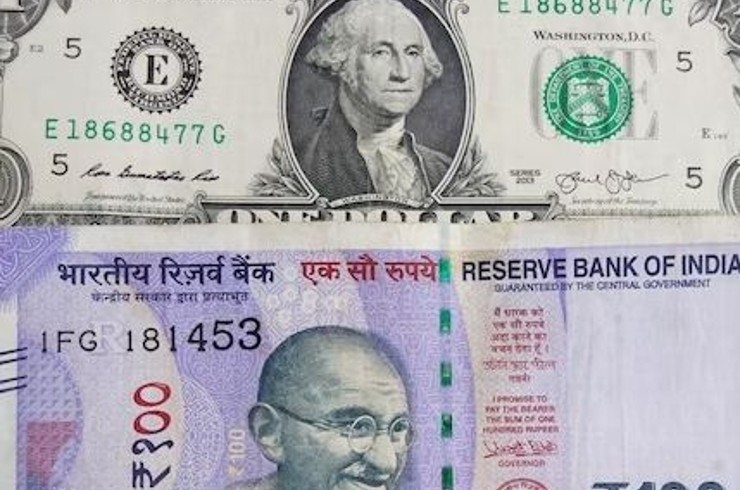
Foreign currency maintained by a country's central bank is known as its Forex reserves. It offers protection from unforeseen external shocks. Image Source: IANS
India’s foreign exchange reserves declined by $4.38 billion to $690.72 billion in the week ending August 22, according to data released by the Reserve Bank of India (RBI) on Friday.
India’s foreign exchange reserves, currently at $695 billion, are strong enough to cover 11 months of merchandise exports, Reserve Bank of India (RBI) Governor Sanjay Malhotra said on Monday, August 25, describing them as a safeguard against external risks. Speaking at the annual FIBAC banking conference in Mumbai, he noted that the RBI generally measures reserves against imports, not exports.
Malhotra attributed the record reserves to prudent fiscal and monetary management by the government and regulators in recent years, coupled with structural reforms and productivity gains. He emphasized that the Monetary Policy Committee would continue to prioritize price stability while fostering growth. According to him, supply-side interventions and monetary measures have kept CPI inflation under control, while regulations have been eased when necessary to avoid constraining growth.
At the same time, Malhotra flagged global risks, pointing to an uncertain trade environment and rising geopolitical tensions. His remarks came just ahead of fresh US tariffs on Indian goods, set to take effect on Wednesday, August 27. The Trump administration has announced a steep 25 per cent hike, doubling duties to 50 per cent, citing India’s continued purchases of Russian crude oil. In FY24, Indian exports to the US were valued at $86.5 billion, accounting for roughly one-fifth of total outbound shipments. The Indian government has denounced the tariffs as unfair and vowed to respond in the nation’s best interest.
He said the Monetary Policy Committee would keep its focus on price stability while supporting growth. “Supply-side measures and monetary policy have helped contain CPI inflation. Stringent regulations may impede economic growth, and rules have been relaxed when the context demanded,” he said.

Source: Reserve Bank of India
India’s foreign exchange reserves declined by $4.38 billion to $690.72 billion in the week ending August 22, according to data released by the Reserve Bank of India (RBI) on Friday. This came after reserves had risen by $1.48 billion to $695.10 billion in the previous week, and remained below the all-time high of $704.885 billion recorded at the end of September 2024.
During the week ending August 15, foreign currency assets (FCAs), which form the bulk of the reserves fell by $3.65 billion to $582.25 billion, the RBI reported. In dollar terms, FCAs also capture fluctuations in non-dollar currencies like the euro, pound, and yen held in the reserve basket.
Gold reserves rose/fell by $665 million, reaching $66.58 billion in the latest week. Special Drawing Rights (SDRs) also declined by $46 million to $18.73 billion. Meanwhile, India’s reserve position with the International Monetary Fund (IMF) slipped by $23 million to $4.73 billion, the data showed.
Foreign currency maintained by a country's central bank is known as its Forex reserves. It offers protection from unforeseen external shocks. Typically, reserve currencies like the dollar are used to maintain it. The fundamental goal of holding foreign exchange reserves is to preserve confidence in the monetary and exchange rate management policies as well as to preserve currency liquidity to absorb external shocks. Also, having sufficient reserves helps reassure investors in times of extreme uncertainty, such as wars or unrest, portrays a positive image, and reassures trading countries.
Which countries have the highest foreign reserves?
As of July 2025, China holds nearly $3.2 trillion in foreign exchange reserves, the largest in the world, reflecting the strength of its economy. These reserves are composed of a mix of assets, including foreign currencies, gold, bonds, and other financial instruments.
Japan ranks second globally, with $1.3 trillion in reserves, and remains the biggest holder of U.S. securities. The composition of Japan’s reserves in July 2025 included $1.13 trillion in foreign currency assets, $89.7 billion in gold, and around $71 billion in IMF reserve positions and Special Drawing Rights (SDRs).
Switzerland’s foreign exchange reserves were about $897.6 billion in July 2025, managed by its central bank through a diversified portfolio. Of this, gold accounted for $112.6 billion, while other reserve assets stood at roughly $0.021 billion, alongside notable increases in SDRs and IMF reserve holdings.
By mid-August 2025, India’s foreign exchange reserves were valued at $695.10 billion. Of this, foreign currency assets (FCAs) made up the largest share at $585.90 billion, spread across major currencies such as the U.S. dollar, euro, and Swiss franc. The remainder comprised gold holdings, SDRs, and India’s reserve position with the IMF.
India holds the position of the fourth-largest country in terms of foreign exchange reserves, trailing only behind China, Japan, and Switzerland.