Friday, 23 Oct, 2026

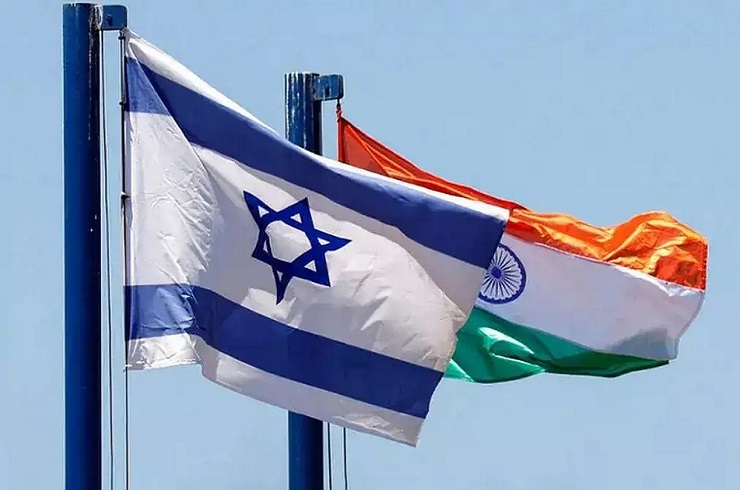
Prime Minister Narendra Modi’s two-day state visit to Israel, from February 25–26, came at the invitation of Prime Minister Benjamin Netanyahu and included a high-level Indian delegation of senior ministers and officials. Image Source: VIF
he two sides agreed to develop a multi-year strategic programme, including joint research, human capacity building, tabletop exercises and integration of Security by Design principles.
In a landmark visit that signals a new high in bilateral ties, Prime Minister Narendra Modi and Prime Minister Benjamin Netanyahu have elevated India–Israel relations to a “Special Strategic Partnership for Peace, Innovation & Prosperity,” pledging deeper collaboration across defence, emerging technologies, trade, agriculture, cybersecurity and education. Prime Minister Narendra Modi’s two-day state visit to Israel, from February 25–26, came at the invitation of Prime Minister Benjamin Netanyahu and included a high-level Indian delegation of senior ministers and officials. The visit builds on the momentum of Modi’s historic 2017 trip to Israel and Netanyahu’s 2018 visit to India, which together reshaped the trajectory of ties between the two nations.
A future driven by innovation
At the heart of the upgraded partnership is a shared belief that India and Israel are natural innovation allies. While Israel has established itself as a global technology powerhouse, India offers scale, talent, manufacturing depth and a dynamic startup ecosystem. The two leaders agreed to integrate their strengths in artificial intelligence, cybersecurity, semiconductors, quantum computing, biotechnology, agriculture, water management, defence systems and space exploration.
They announced a new initiative on Critical and Emerging Technologies to be led by the National Security Advisors of both countries, aimed at creating focused collaboration in cutting-edge sectors. A Memorandum of Understanding on cooperation in Artificial Intelligence was signed, underscoring AI as a central pillar of the future partnership.
In a major boost to scientific collaboration, both sides agreed to increase funding for the India-Israel Joint Research Calls from $1 million to $1.5 million each. The India-Israel Industrial R&D and Innovation Fund will also be strengthened to accelerate high-quality joint industrial research. The Joint Commission on Science and Technology has been elevated to the ministerial level, signaling greater political backing for scientific cooperation. Space cooperation also featured prominently. The leaders welcomed growing collaboration between the Israel Space Agency and the Indian Space Research Organisation, encouraging stronger ties between private space industries and startups in both countries.
Defence and cybersecurity take centre stage
Defence ties received renewed momentum, with both leaders welcoming the Memorandum of Understanding on Defence Cooperation signed in November 2025 and outlining a forward-looking roadmap for expanded collaboration. Cybersecurity emerged as another major focus. The two sides agreed to develop a multi-year strategic programme, including joint research, human capacity building, tabletop exercises and integration of Security by Design principles. A Letter of Intent was signed to establish an India-Israel Centre of Excellence in Cybersecurity in India.
In the financial sector, both leaders highlighted cooperation on financial cyber resilience, including joint simulations and intelligence-sharing between financial computer security incident response teams.
Trade, fintech and connectivity surge ahead
Economic ties are set for a major boost. The leaders welcomed the signing of the India-Israel Bilateral Investment Agreement in September 2025 and the launch of negotiations for a Free Trade Agreement, with instructions to negotiators to expedite discussions. In a move that could transform cross-border payments, India and Israel will explore linking India’s Unified Payments Interface with Israel’s fast payment system. An MoU between NPCI International Payments Limited and MASAV was signed to examine payment system linkages.
The two sides also called for expanding direct air connectivity between Tel Aviv and major Indian cities to accelerate tourism, business and people-to-people exchanges. Indian companies were encouraged to participate in major Israeli infrastructure projects, including metro systems, railways, roads, airports, desalination and wastewater treatment plants.
Agriculture, water and climate collaboration deepen
Water and agriculture, long-standing pillars of cooperation, received renewed attention. The leaders reviewed progress at 35 operational Centres of Excellence in agriculture across India, with eight more being developed. Over one million Indian farmers have benefited from these centres so far.
An MoU was signed to establish the India–Israel Innovation Centre for Agriculture, and 20 joint agricultural research fellowships were launched in collaboration with Israel’s Volcani Agriculture Research Organization. Both sides also agreed to strengthen cooperation in fisheries and aquaculture, including the creation of a Joint Centre of Excellence. Environmental protection and climate action will see expanded collaboration, including capacity building, technology transfer and promotion of circular economy practices.
Strong stance on terror, push for peace
The leaders strongly condemned terrorism in all its forms, including cross-border terrorism. They denounced the October 7, 2023 terror attack on Israel, the April 22, 2025 attack on Indian tourists in Pahalgam, and the November 10, 2025 incident near Red Fort in New Delhi. They reiterated their commitment to global peace and security and discussed regional developments, including efforts to achieve a durable peace in the Middle East.
People, education and workforce mobility
People-to-people ties were given special emphasis. Both leaders acknowledged the contribution of Indian workers in Israel and agreed that up to 50,000 additional Indian workers may arrive over the next five years. New implementation protocols were signed to expand Indian worker mobility into commerce, services, manufacturing and restaurant sectors. In education, the two sides agreed to establish the India-Israel Academic Cooperation Forum, an annual platform for universities and policymakers. A new MoU was signed between Nalanda University and the Hebrew University of Jerusalem, along with an agreement to advance education through AI.
Cultural cooperation will also expand, with a new Cultural Exchange Programme for 2026–2029 aimed at boosting collaboration in cinema, joint productions and artistic exchanges.
A broader global vision
The leaders reaffirmed their commitment to multilateral and regional initiatives such as the I2U2 partnership and discussed advancing the India-Middle East-Europe Economic Corridor, highlighting Israel’s potential role in strengthening regional connectivity and trade. In total, 16 agreements and understandings were signed during the visit, covering AI, cybersecurity, agriculture, fisheries, geophysical exploration, maritime heritage, arbitration cooperation and financial regulatory collaboration.
As the visit concluded in Jerusalem, both leaders reaffirmed their shared vision: an enduring India–Israel partnership powered by technology, entrepreneurship and democratic values and geared toward shaping a more innovative, secure and prosperous future for both nations.