Saturday, 03 Oct, 2026

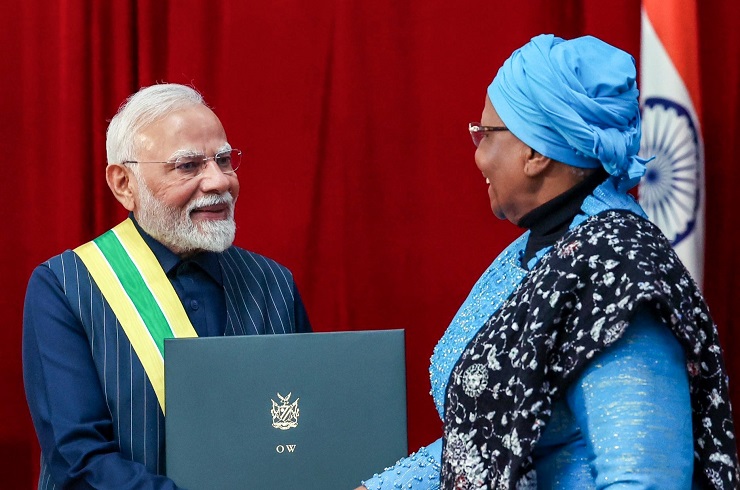
The two sides emphasised the need to convert discussions into concrete outcomes through clearly defined mechanisms, timelines and institutional responsibilities. Image Source: DD India
The economic relationship, however, is increasingly acquiring a strategic dimension through cooperation in critical minerals. India and Namibia have identified lithium, graphite, copper, cobalt and rare earth elements as important areas for future collaboration.
The Fourth Session of the India-Namibia Joint Trade Committee (JTC), held in New Delhi on 10–11 August 2026, marked an important step in strengthening the economic partnership between the two countries. The discussions focused not only on expanding bilateral trade but also on transforming the nature of economic engagement by moving beyond Namibia’s traditional role as a supplier of raw materials towards greater value addition, local processing and employment generation within Namibia.
The two sides emphasised the need to convert discussions into concrete outcomes through clearly defined mechanisms, timelines and institutional responsibilities. The JTC, which serves as the principal bilateral institutional mechanism for reviewing trade, investment and economic cooperation, provided a platform to advance collaboration across a broad range of sectors, including agriculture and food security, micro, small and medium enterprises (MSMEs), textiles, tourism and sports. The cordial and constructive nature of the discussions also reflected the longstanding political and people-to-people ties between India and Namibia.
Bilateral trade has continued to expand steadily. Merchandise trade increased to USD 592.94 million in 2025–26 from USD 568.40 million in 2024–25. India's exports stood at USD 349.09 million, while imports from Namibia reached USD 243.85 million. Services trade has also emerged as an important component of the relationship, growing by 7.34 per cent to USD 380 million in calendar year 2024. India's engineering exports to Namibia recorded particularly strong growth, rising by 124.06 per cent to USD 30.24 million, driven largely by motor vehicles and components. India's pharmaceutical and medical-device exports reached USD 36.50 million, making India Namibia's second-largest source of pharmaceuticals, with a 16.4 per cent share of its pharmaceutical imports.

Source: Ministry of Commerce and Industry
The economic relationship, however, is increasingly acquiring a strategic dimension through cooperation in critical minerals. India and Namibia have identified lithium, graphite, copper, cobalt and rare earth elements as important areas for future collaboration. The two countries are looking at cooperation across the entire critical-mineral value chain, encompassing exploration, offtake arrangements, processing and downstream beneficiation. Such an approach is particularly significant for Namibia, which seeks to capture a larger share of the economic value generated from its natural resources through local processing and employment, while providing India with opportunities to diversify and secure supplies of minerals essential for clean energy, advanced manufacturing, electronics and other strategic industries.
India should also consider expanding this mineral partnership to include uranium. Namibia possesses substantial uranium resources and is among the world's important uranium-producing countries. For India, reliable access to uranium is strategically significant because nuclear power remains an important component of its long-term strategy to expand reliable, low-carbon electricity generation. India's civil nuclear programme depends on secure and diversified supplies of nuclear fuel, making cooperation with resource-rich partners such as Namibia potentially valuable. Engagement could explore long-term supply arrangements, subject to India's nuclear safeguards, non-proliferation commitments and applicable international obligations. Cooperation in uranium would therefore complement India's wider efforts to build resilient strategic mineral and energy supply chains while deepening Namibia's integration into India's broader economic partnership with Africa.
The growing economic engagement also builds on a relationship that has deep political roots. India was among the earliest countries to raise the issue of Namibian independence at the United Nations, doing so as early as 1946. India's support for Namibia's liberation struggle continued over subsequent decades. The first SWAPO diplomatic mission abroad was established in New Delhi in 1986, while India supported Namibia's liberation movement through diplomatic backing, including at the Non-Aligned Movement, as well as material assistance and military training. These historical ties have created a strong foundation upon which the contemporary economic relationship can be built.
The India-Namibia partnership also forms part of India's broader effort to deepen engagement with the Global South. India's Global South policy is centred on strengthening partnerships with developing and emerging economies through trade, development cooperation, capacity building, technology sharing, connectivity and greater representation in global institutions. Rather than viewing these relationships purely through the lens of conventional trade, India has increasingly sought to build partnerships based on mutual development priorities and the principle of shared growth.
This approach was particularly visible during India's G20 Presidency, when New Delhi placed the concerns of developing countries at the centre of the global economic agenda and helped secure the African Union's permanent membership in the G20. Initiatives such as the Voice of Global South Summit have further provided developing countries with a platform to articulate their priorities on food and energy security, climate finance, debt, digitalisation, development and global governance. India's engagement with Africa is an important pillar of this broader strategy, combining commercial interests with development partnerships, capacity building, technology cooperation and diplomatic engagement.
The India-Namibia relationship therefore represents more than an expansion of bilateral trade. It illustrates India's evolving approach to partnerships across the Global South, where economic engagement is increasingly linked to strategic resilience, local value creation and long-term development. For Namibia, deeper cooperation with India can provide access to technology, markets, pharmaceuticals, engineering products and investment while supporting its ambition to develop domestic processing capabilities. For India, Namibia offers an opportunity to strengthen its presence in southern Africa and build more diversified supply chains for critical minerals and potentially nuclear fuel.
The timing is also significant in the context of India's wider trade engagement with southern Africa. The terms of reference for an India-Southern African Customs Union (SACU) preferential trade agreement have been finalised, with the five-member grouping comprising Namibia, South Africa, Botswana, Eswatini and Lesotho. The agreement is expected to provide a broader framework for expanding India's commercial engagement with the region, with negotiations scheduled to commence following its signing.
The next challenge will be implementation. The fifth session of the India-Namibia Joint Trade Committee is scheduled to be held in Namibia in 2028, providing the two countries with an opportunity to assess progress on the commitments made in New Delhi. By then, the success of the partnership will depend on whether the two sides can translate their growing political goodwill into investments, processing facilities, technology partnerships, mineral offtake arrangements and stronger private-sector linkages.
India's engagement with Namibia is consequently moving from a conventional trade relationship towards a more comprehensive strategic economic partnership. By combining its historical political goodwill with cooperation in critical minerals, pharmaceuticals, engineering, agriculture, technology and potentially uranium, India can deepen its relationship with Namibia while advancing a larger objective: building resilient supply chains and mutually beneficial partnerships across the Global South.