Tuesday, 10 Nov, 2026

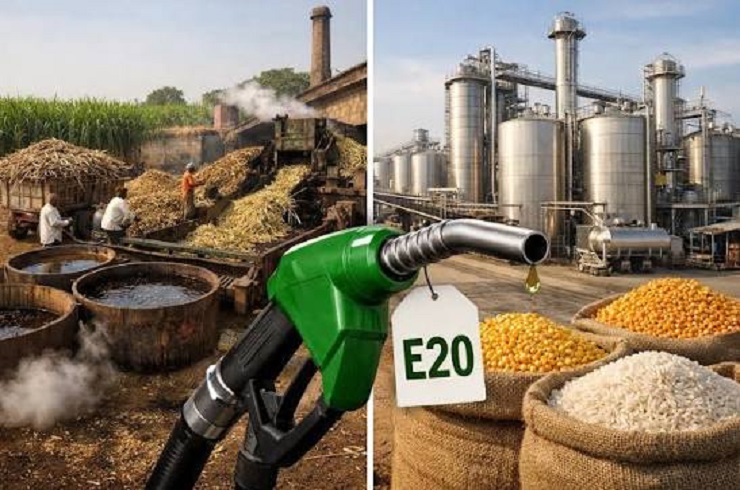
Under the new provisions, ethanol production from surplus Food Corporation of India (FCI) rice has been capped at 3.24 billion litres for the first three quarters of the supply year. Image Source: Edhas Biofuel
The restrictions are intended to regulate the diversion of foodgrains towards fuel production, particularly at a time when concerns over food availability and competing consumption requirements are gaining prominence.
The government has introduced fresh restrictions on the use of surplus rice and damaged foodgrains for ethanol production in the 2026-27 Ethanol Supply Year (ESY), signalling a shift in its approach towards balancing the country’s fuel-blending ambitions with foodgrain availability. The move, which follows an earlier decision to discontinue the diversion of most sugarcane-based feedstocks for ethanol, is expected to increase dependence on maize, potentially intensifying competition for the grain between the ethanol, poultry, dairy and starch industries.
The revised conditions, issued on November 3, were incorporated into a tender floated by oil marketing companies (OMCs) for the procurement of 1,100 crore litres (11 billion litres) of denatured anhydrous ethanol for the 2026-27 supply year, which runs from November 2026 to October 2027. Under the new provisions, ethanol production from surplus Food Corporation of India (FCI) rice has been capped at 3.24 billion litres for the first three quarters of the supply year. Separately, ethanol derived from damaged foodgrains has been subjected to an annual ceiling of 1.6 billion litres. Taken together, these two sources can contribute a maximum of 4.84 billion litres, accounting for approximately 44 percent of the total procurement requirement.

The restrictions are intended to regulate the diversion of foodgrains towards fuel production, particularly at a time when concerns over food availability and competing consumption requirements are gaining prominence. Damaged foodgrains, despite being unsuitable or unfit for certain forms of human consumption, are also utilised as food and animal feed. The government has therefore restricted their use for ethanol production to 400 million litres per quarter, amounting to 1.6 billion litres over the entire supply year. According to agricultural markets expert GK Sood, the restriction reflects the emerging concern over foodgrain availability, as damaged grains also contribute to the country's food and feed requirements.
The revised tender has also introduced tighter controls on the allocation of surplus FCI rice. Individual ethanol producers will be permitted to offer rice-based ethanol only up to 30 percent of their total quarterly bids. At the aggregate level, OMCs will procure a maximum of 1.08 billion litres of ethanol from this source in each of the first three quarters, taking the cumulative ceiling to 3.24 billion litres. In the event that bids exceed the prescribed limit, allocations will be proportionately reduced across eligible producers. This effectively places restrictions both on the quantity that an individual manufacturer can offer and the overall volume that OMCs can procure.
The three-quarter allocation corresponds to approximately 7.2 million tonnes of surplus rice earmarked by the government for the Ethanol Blended Petrol (EBP) programme. This allocation will remain valid until June 30, 2027. The restrictions indicate that although surplus rice will continue to remain an important feedstock, its contribution to ethanol production will be closely regulated during the coming supply year.
These measures follow the government's October 16 decision to eliminate the diversion of sugar and certain sugarcane-based feedstocks for ethanol production in 2026-27. In the initial years of the EBP programme, sugarcane-based feedstocks, particularly sugarcane juice, sugar syrup and B-heavy molasses, played a significant role in expanding ethanol production. The diversion of these materials allowed sugar mills to generate additional revenue from their operations while helping them clear pending payments to sugarcane farmers. However, concerns over lower sugar production and the need to maintain adequate domestic supplies prompted the Centre to reconsider this arrangement.
Consequently, the next ethanol procurement tender, issued through Bharat Petroleum Corporation Limited (BPCL) on behalf of OMCs, did not invite bids for ethanol produced from sugarcane juice, sugar, sugar syrup or B-heavy molasses. The Department of Food and Public Distribution subsequently instructed sugar-producing states to ensure that these feedstocks were not diverted for ethanol production during the 2026-27 supply year. The restriction, however, does not extend to C-heavy molasses, which is the residual by-product generated after most of the recoverable sugar has been extracted from sugarcane. With mills expected to retain more sugarcane juice and B-heavy molasses for sugar production, the availability of C-heavy molasses is likely to increase. Nevertheless, its contribution to OMC procurement may remain relatively limited. Sood estimates that only around 500 million litres of ethanol produced from C-heavy molasses could be available for diversion to OMCs, partly because the product is relatively inexpensive and also faces competition from the alcohol and other industrial sectors.
With sugarcane-based feedstocks largely excluded and the use of surplus rice and damaged foodgrains capped, maize is expected to emerge as the principal alternative feedstock for meeting the country's ethanol requirements. Industry estimates indicate that maize consumption for ethanol production could increase from approximately 13 million tonnes in the current supply year to nearly 16 million tonnes in 2026-27, representing an increase of around 22 percent. At an estimated conversion rate of 380 litres of ethanol per tonne of maize, this quantity could generate approximately 6.1 billion litres of ethanol, making maize a critical component of the country's fuel-blending programme.
However, the anticipated increase in ethanol-related demand is likely to place additional pressure on an already competitive maize market. Maize is an essential raw material for poultry feed, dairy feed, starch manufacturing and several other industrial applications. A substantial increase in its consumption by ethanol manufacturers could therefore create a direct competition between fuel producers and industries that depend on the grain for their regular operations. The emerging pressure is already visible in market prices, with maize prices in major mandis reportedly touching ₹30-31 per kg, considerably higher than the Minimum Support Price (MSP) of ₹24.10 per kg.
Industry projections suggest that India's overall maize demand, covering ethanol production, animal feed, starch and other industrial applications, could rise to approximately 55.7 million tonnes in 2027, compared with an estimated 49-50 million tonnes in 2026. This increase in demand comes amid concerns over the country's production outlook. The possibility of an El Niño weather pattern, coupled with inadequate soil moisture, has raised concerns about potential disruptions to maize cultivation and yields. Estimates cited by industry representatives suggest that maize availability could decline by around 15 percent this year, further tightening the supply situation.
The government's latest restrictions therefore highlight an emerging challenge for India's ethanol-blending programme. While the expansion of ethanol production remains central to reducing dependence on imported crude oil and diversifying the country's fuel mix, the availability of suitable feedstocks is becoming an increasingly important constraint. With sugarcane-based diversion curtailed and rice-based ethanol subject to tighter allocations, the growing reliance on maize could intensify price pressures and competition among fuel, food, feed and industrial users. The coming supply year will consequently test the government's ability to advance its ethanol-blending targets without creating additional stress on domestic foodgrain supplies and agricultural commodity markets.