Thursday, 17 Sep, 2026

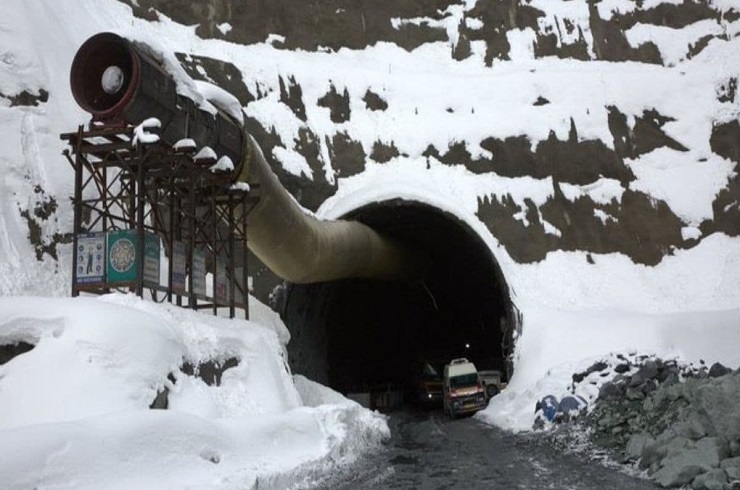
The project is being executed by the National Highways and Infrastructure Development Corporation Limited (NHIDCL), while Megha Engineering and Infrastructure Limited (MEIL) is responsible for construction. Imgae Credits: NDTV
Once completed, the Zojila Tunnel will become the world's longest bi-directional road tunnel at such a high altitude and will fundamentally transform civilian and military mobility in one of India's most strategically important regions.
India's ambitious Zojila Tunnel project has crossed a critical milestone with the successful completion of the excavation phase, bringing the country significantly closer to achieving all-weather road connectivity between the Kashmir Valley and Ladakh. The breakthrough, achieved on Tuesday, marks the moment when excavation teams working from opposite ends of the tunnel finally met, signaling the end of one of the most challenging phases of construction.
Once completed, the Zojila Tunnel will become the world's longest bi-directional road tunnel at such a high altitude and will fundamentally transform civilian and military mobility in one of India's most strategically important regions.
Located at an altitude of 11,758 feet, the 13-kilometre-long tunnel stretches between Baltal near Sonamarg in Kashmir and Minimarg near Drass in Ladakh's Kargil district. The project bypasses the notoriously dangerous Zojila Pass, which rises to approximately 16,430 feet and remains inaccessible for several months each year due to heavy snowfall, avalanches, landslides, and severe weather conditions.
The tunnel forms the central component of the larger 30.894-kilometre Zojila infrastructure project that includes approach roads, bridges, ventilation shafts, auxiliary tunnels, snow galleries, and other support structures designed to ensure uninterrupted connectivity throughout the year. Upon completion, the tunnel is expected to shorten the distance between Sonamarg and Drass by nearly 27 kilometres while reducing travel time by more than two hours.
In tunnel engineering, a breakthrough represents the point at which excavation teams working from opposite directions remove the final section of rock separating them. It signifies the successful completion of excavation work and allows engineers to move toward the next phases, including lining, drainage, ventilation, electrical systems, and safety installations. The excavation of the Zojila Tunnel was carried out using the New Austrian Tunnelling Method (NATM), a technique particularly suited to the fragile and unpredictable geological conditions of the Himalayas.
According to project officials, NATM involves sequential excavation combined with immediate stabilisation measures such as rock bolting, shortcrete support, and continuous geological monitoring. This approach allows engineers to adapt construction techniques based on changing rock conditions, significantly enhancing safety and structural stability in difficult mountain terrain.
The Zojila Tunnel project, estimated to cost approximately ₹6,800 crore, was inaugurated by Prime Minister Narendra Modi in May 2018.
Although originally targeted for completion by September 2026, several factors contributed to delays. These included disruptions caused by the COVID-19 pandemic, difficult weather conditions in the Himalayan region, and security concerns following the 2024 terrorist attack on workers involved in the nearby Z-Morh Tunnel project. As a result, the revised completion deadline has now been pushed to February 2028.
The project is being executed by the National Highways and Infrastructure Development Corporation Limited (NHIDCL), while Megha Engineering and Infrastructure Limited (MEIL) is responsible for construction.
Beyond its transportation benefits, the Zojila Tunnel carries immense strategic significance for India's national security architecture. Ladakh remains connected to the rest of India through two major road corridors, the Srinagar-Sonamarg-Leh Highway and the Leh-Manali Highway. However, both routes are frequently closed for nearly six months annually due to heavy snowfall and extreme weather conditions, leaving the region heavily dependent on costly and weather-sensitive airlift operations.
The tunnel will eliminate this vulnerability by providing uninterrupted surface connectivity throughout the year. For the Indian Armed Forces, this translates into a substantial enhancement in operational readiness. The tunnel will facilitate rapid deployment of troops, armoured vehicles, ammunition, fuel supplies, and logistics support to forward areas along both the Line of Actual Control (LAC) with China and the Line of Control (LoC) with Pakistan.
Military planners have long viewed all-weather access to Ladakh as a strategic necessity, particularly in light of evolving security challenges along India's northern frontiers.
The tunnel's strategic value is underscored by lessons learned during the 1999 Kargil War, when Pakistani artillery targeted key transportation routes linking Kashmir and Ladakh. By moving a significant portion of traffic underground, the tunnel reduces exposure to enemy surveillance, artillery fire, and other battlefield threats. It therefore not only improves mobility but also strengthens the survivability and resilience of critical military logistics networks.
While excavation has been completed, significant work remains before the tunnel becomes operational. Engineers are currently focusing on:
Project officials indicate that approximately 3 kilometres of the tunnel's inner lining has already been completed, with the remaining work expected to take around one year. Among the most challenging remaining tasks is the completion of the vertical shafts. One of these shafts extends 474.3 metres vertically and stands at an elevation of 3,481 metres, making it the longest vertical tunnel shaft in India.
The broader Zojila project encompasses far more than the main tunnel itself. Key elements include:
Most of these components have already been completed or are nearing completion.
The Zojila Tunnel complements the recently inaugurated Sonamarg Tunnel, previously known as the Z-Morh Tunnel. Opened to traffic in January 2025, the 6.5-kilometre Sonamarg Tunnel ensures year-round access to the popular tourist destination of Sonamarg, which was historically cut off during winter due to heavy snowfall and avalanche risks.
Together, the Sonamarg and Zojila tunnels are expected to create a reliable, all-weather transportation corridor linking Kashmir and Ladakh for the first time in history.
The Zojila Tunnel will soon join a growing network of major road tunnels that are reshaping transportation across India's mountainous regions.
At 9.28 kilometres, the Dr. Syama Prasad Mookerjee Tunnel remains India's longest fully operational highway tunnel. Constructed on National Highway 44, it has dramatically improved connectivity between Jammu and Srinagar by reducing travel time by more than two hours and providing a safer alternative to the accident-prone mountain roads.
The 9.02-kilometre Atal Tunnel passes beneath the Pir Panjal Range at an altitude exceeding 10,000 feet. Opened in 2020, it bypasses the Rohtang Pass and shortens the route between Manali and the Lahaul-Spiti region by approximately 46 kilometres, greatly improving year-round accessibility.
This modern 8.45-kilometre twin-tube tunnel provides a safer and faster route beneath the Pir Panjal mountains. Situated at an elevation of around 1,800 metres, it replaced the older Jawahar Tunnel route and significantly improves winter connectivity to the Kashmir Valley.
The 6.5-kilometre Sonamarg Tunnel ensures uninterrupted access to Sonamarg throughout the year. Prior to its construction, the region remained isolated during winter months due to snow accumulation and avalanche threats.
Commissioned in the 1950s, the 2.85-kilometre Jawahar Tunnel was one of India's earliest major mountain tunnels. Located at an elevation of 2,194 metres beneath the Pir Panjal Range, it served for decades as the primary all-weather gateway connecting Jammu with the Kashmir Valley.
The successful breakthrough of the Zojila Tunnel represents far more than an engineering achievement. It is a landmark step in India's broader effort to strengthen infrastructure, improve regional integration, and enhance military preparedness along its northern borders. Once completed, the tunnel will end decades of seasonal isolation for Ladakh, provide a dependable logistics corridor for the armed forces, boost tourism and economic activity, and significantly strengthen India's strategic posture in a region of immense geopolitical importance.