Tuesday, 22 Sep, 2026

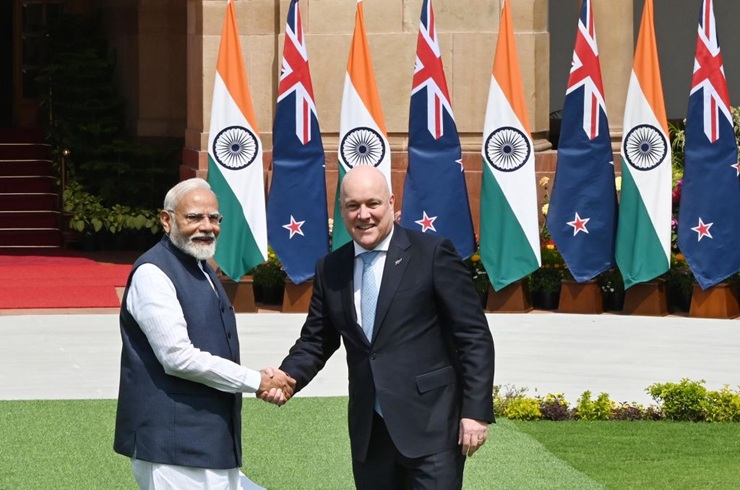
New Zealand has agreed to provide duty-free access for 100 percent of Indian exports from the date the agreement enters into force. Image Source: Getty Images
The agreement, signed in New Delhi on April 27, 2026, represents a significant milestone in a bilateral relationship that has expanded considerably in recent years.
India and New Zealand have taken a significant step towards deepening their economic partnership with the formal ratification of the India-New Zealand Free Trade Agreement (FTA). New Zealand’s Parliament had earlier passed the implementing legislation by a 93-29 vote on September 16, paving the way for ratification. The two countries formally exchanged the ratification documents on September 21, completing New Zealand’s domestic procedures. The agreement is scheduled to enter into force on October 20, 2026.
The agreement, signed in New Delhi on April 27, 2026, represents a significant milestone in a bilateral relationship that has expanded considerably in recent years. The momentum behind the economic partnership was further strengthened by Prime Minister Narendra Modi’s visit to New Zealand in July 2026, the first visit by an Indian Prime Minister to the country in four decades. During the visit, the two sides reaffirmed their commitment to expanding economic engagement and emphasised the importance of bringing the FTA into effect at the earliest.
The FTA is significant not merely because it reduces tariffs, but because it creates a much broader framework for economic engagement encompassing trade in goods and services, investment, skilled mobility, agriculture, intellectual property, MSME cooperation and education. It therefore has the potential to reshape several dimensions of the India-New Zealand economic relationship over the coming years.
At the heart of the agreement is a major expansion in market access. New Zealand has agreed to provide duty-free access for 100 percent of Indian exports from the date the agreement enters into force. This gives Indian exporters an immediate advantage across a wide range of sectors, including textiles and apparel, leather and footwear, engineering products, pharmaceuticals, agricultural goods and processed food. For several Indian industries that compete on price in international markets, the removal of tariffs can improve competitiveness and create opportunities to expand their presence in New Zealand.
India, meanwhile, has adopted a more calibrated approach to opening its own market. It has offered tariff concessions on 70.03 percent of its tariff lines, covering approximately 95 percent of bilateral trade value, while keeping 29.97 percent of tariff lines outside the agreement. The exclusions largely cover sensitive sectors such as dairy, several agricultural products, sugar, certain edible oils, gems and jewellery, and selected metals and metal products. This structure allows India to expand market access while retaining protection for sectors considered particularly sensitive from a domestic perspective.
Within the liberalised tariff lines, the pace of market opening varies. Around 30 percent of India’s tariff lines will see duties eliminated immediately, covering products such as wood, wool, sheep meat and raw hides. Another 35.60 percent will undergo tariff reductions over three, five, seven or ten years. These include products such as petroleum oils, vegetable oils, malt extract and selected machinery. A further 4.37 percent of tariff lines will receive partial tariff reductions covering products such as wine, pharmaceuticals, polymers, aluminium, iron and steel. A small proportion will be governed through tariff-rate quotas, including products such as Mānuka honey, apples, kiwifruit and milk albumin.
The structure of the agreement reflects an attempt to balance greater economic integration with domestic sensitivities. New Zealand’s exporters will gain substantially improved access to the Indian market, while India’s sensitive agricultural and other sectors retain tariff protection. From New Zealand’s perspective, tariffs on or affecting 95 percent of its exports to India will ultimately be eliminated or reduced, with 57 percent of exports becoming duty-free from the first day of implementation.

Source: Ministry of External Affairs (Trade in USD Billion)
The agreement comes at a time when bilateral trade has already been moving upward. Merchandise trade increased from around USD 873 million in 2023–24 to approximately USD 1.3 billion in 2024–25, representing an increase of about 49 percent. Indian exports rose by around 32 percent during the same period to reach approximately USD 711 million. Over the longer term, merchandise trade has increased from around USD 855 million in 2015–16 to nearly USD 1.3 billion in 2024–25, with India maintaining a trade surplus. The services relationship has also expanded, with India’s services exports to New Zealand reaching USD 634 million in 2024, supported by areas such as travel, information technology and business services.
The FTA could give this existing trade relationship a substantially wider base. Lower tariffs can improve the price competitiveness of Indian manufactured and agricultural products, while improved access for New Zealand goods can expand the range of products entering the Indian market. The agreement also establishes a more predictable framework for businesses, potentially encouraging companies on both sides to look beyond the existing trade flows and develop longer-term commercial relationships. The actual pace of trade expansion, however, will depend on factors including global economic conditions, exchange rates, demand and broader commercial considerations.
One of the more distinctive features of the agreement is that its ambitions extend beyond merchandise trade. Workforce mobility has been incorporated into the framework through dedicated pathways for Indian professionals. Up to 5,000 skilled Indian workers will be able to enter New Zealand under the Temporary Employment Entry pathway for periods of up to three years. The eligible occupations extend across sectors such as information technology, engineering, healthcare, education and construction, while also encompassing culturally specific professions including AYUSH practitioners, yoga instructors, Indian chefs and music teachers.
The agreement also places considerable emphasis on students. Indian students studying in New Zealand will be able to work up to 20 hours a week during their studies, while post-study work opportunities have been extended for graduates in STEM disciplines. Bachelor’s and master’s graduates can receive up to three years of post-study work rights, while doctoral candidates can receive up to four years. These provisions create an additional link between education, skilled mobility and the wider economic relationship.
Investment represents another major pillar of the agreement. New Zealand has committed to facilitating USD 20 billion of investment into India over a 15-year period. The commitment is expected to support areas including manufacturing, infrastructure, renewable energy, agricultural technology, emerging technologies, innovation and skills development, while also creating opportunities for startups, MSMEs and women-led enterprises.
The investment commitment is accompanied by a rebalancing mechanism. This provides a framework through which market-access conditions can be recalibrated if there is a significant shortfall in the delivery of the investment commitments. In effect, the agreement seeks to link improved access to the Indian market with a longer-term expectation of greater investment participation by New Zealand.
Agriculture forms another important component of the partnership. Rather than limiting cooperation to tariff reductions, India and New Zealand have agreed to establish an Agricultural Productivity Partnership aimed at improving productivity, technology adoption and integration into global value chains. The initiative focuses on areas including apples, kiwifruit and honey and is intended to complement calibrated market access with cooperation on agricultural productivity and quality.
For India’s pharmaceutical and medical-device sectors, the agreement also offers opportunities to streamline market access. Provisions relating to the recognition of inspection reports from comparable international regulators can help facilitate approvals and reduce some of the regulatory barriers faced by exporters. This could be particularly relevant for Indian companies seeking to expand their footprint in the New Zealand market.
The FTA also places emphasis on smaller businesses. Cooperation mechanisms for micro, small and medium enterprises are intended to improve access to trade information, export-readiness programmes and New Zealand’s SME ecosystem. By specifically encouraging participation by startups and enterprises led by women and young entrepreneurs, the agreement seeks to ensure that the benefits of greater market access extend beyond large corporations.
Intellectual property protection adds another layer to the agreement. New Zealand has committed to amend its legislation within 18 months to strengthen protection for Indian geographical indications to a level comparable with European standards. This is particularly relevant for Indian products whose commercial value is closely linked to their geographical identity and traditional production practices.
The agreement also contains detailed Product Specific Rules of Origin designed to ensure that tariff preferences are available to products that genuinely qualify under the agreement. Such rules are important in preventing circumvention, misrepresentation or transshipment of goods through either country simply to obtain preferential tariff treatment.
Underlying this expanding economic relationship is an important people-to-people dimension. New Zealand is home to a large Indian-origin and Indian diaspora community, estimated at around 300,000 people. The community has become an important social, cultural and economic link between the two countries, contributing to business networks, education, professional mobility and demand for Indian products and services.
Taken together, these provisions make the India-New Zealand FTA considerably broader than a conventional tariff-reduction agreement. It combines market access with investment commitments, skilled mobility, education opportunities, agricultural cooperation, MSME support and stronger intellectual property protections. The agreement consequently provides the institutional framework for India and New Zealand to move from a relatively modest trading relationship towards a more diversified economic partnership.
The immediate impact will be visible in tariff reductions and improved market access once the agreement enters into force on October 20. Its longer-term significance, however, will depend on how effectively businesses utilise the new opportunities, how investment commitments translate into actual projects, and how successfully the two countries implement the mobility, agriculture, education and regulatory provisions.
For India, the agreement creates a larger export opportunity in a developed market while preserving protections for several sensitive domestic sectors. For New Zealand, it opens substantially greater access to one of the world’s largest consumer markets. More broadly, the FTA provides both countries with a framework to build a relationship that extends well beyond traditional trade.
With the agreement now ratified and its entry into force approaching, India and New Zealand are moving into the implementation phase of what could become a significant new chapter in their economic relationship. The success of the partnership will ultimately be measured not by the breadth of the agreement on paper, but by the extent to which businesses, workers, students, farmers and communities on both sides are able to convert its provisions into tangible economic opportunities.