Friday, 16 Oct, 2026

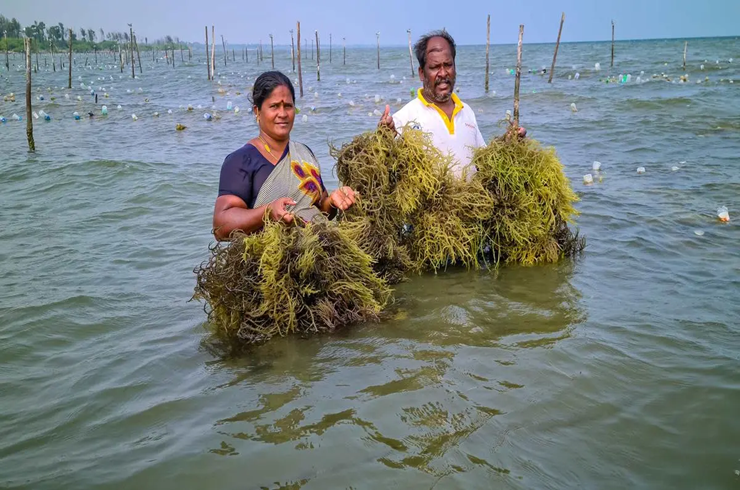
Worldwide output has tripled since 2000, reaching about 32.4 million tonnes in 2020 with an estimated market value of US$13.3 billion. Image Source: Business Line
India’s seaweed sector, currently valued at around ₹300–500 crore, is projected to grow significantly, with production targets of 9.7 million tonnes by 2030.
India is stepping up efforts to harness the economic potential of seaweed cultivation along its 11,099-kilometre-long coastline, with the government identifying hundreds of suitable sites and rolling out policy and financial support to accelerate the sector’s growth. Research institutions including the ICAR–Central Marine Fisheries Research Institute (CMFRI) and the CSIR–Central Salt and Marine Chemicals Research Institute (CSMCRI) have conducted nationwide site mapping, identifying 384 potential locations covering about 24,707 hectares across coastal States and Union Territories for large-scale seaweed farming.
The Department of Fisheries under the Government of India has been actively promoting seaweed cultivation, value addition, and market linkages through a combination of schemes, initiatives, and policy interventions. A key vehicle for this push has been the Pradhan Mantri Matsya Sampada Yojana (PMMSY), implemented from 2020–21 to 2025–26, under which seaweed cultivation has been prioritised as a strategic activity. Financial assistance is being provided for installing cultivation infrastructure such as rafts, monolines and tubenets, establishing seed banks and hatcheries, setting up a multipurpose seaweed park, and supporting training, research, capacity building and pre-feasibility studies. Over the past five years, projects worth ₹198.17 crore have been approved under PMMSY for seaweed cultivation and related activities.
In parallel, the Department of Fisheries is working to boost domestic utilisation of seaweed and stimulate demand-led growth of the seaweed economy. Efforts are also underway to raise awareness among coastal communities and industry stakeholders about the economic and environmental benefits of seaweed farming. As part of cluster-based development, Lakshadweep has been designated a Seaweed Cluster, while the Mandapam Regional Centre of ICAR-CMFRI has been notified as a Centre of Excellence for seaweed development to strengthen research, technology transfer and skill development.

Source: Ministry of Fisheries, Animal Husbandry & Dairying
A major infrastructure initiative in this sector is the Multipurpose Seaweed Park approved in Tamil Nadu, which aims to integrate cultivation, processing and product development. The park is expected to encourage the production of seaweed-based products for diverse applications including food, nutraceuticals, pharmaceuticals, cosmetics and agriculture. To support research and commercialisation, the Department of Fisheries has also issued guidelines for the import of seaweed germplasm, while NITI Aayog has released a dedicated policy report outlining a roadmap for the sector’s development.
Capacity building and awareness generation remain central to the government’s approach. Training programmes, demonstrations, exposure visits and master trainer initiatives on Good Management Practices are being conducted by the National Fisheries Development Board in collaboration with State Fisheries Departments and research institutions such as ICAR-CMFRI and CSIR-CSMCRI. At the state level, Andhra Pradesh has reported capacity building and skill development initiatives for 1,440 self-help groups and fisherfolk across 12 coastal districts, supported by funding from the Green Climate Fund project and AFCOF-CBBO.
Approved units of Establishment of Seaweed culture rafts including inputs

Source: Ministry of Fisheries, Animal Husbandry & Dairying
This information was shared by Union Minister for Fisheries, Animal Husbandry and Dairying Rajiv Ranjan Singh, also known as Lalan Singh, in a written reply in the Lok Sabha, underscoring the government’s intent to position seaweed cultivation as a key pillar of India’s emerging blue economy.
Global seaweed production has expanded rapidly over the past two decades, emerging as a climate-resilient, nutrient-rich and high-value bioresource for the blue economy. Worldwide output has tripled since 2000, reaching about 32.4 million tonnes in 2020 with an estimated market value of US$13.3 billion. Asia dominates the sector, accounting for nearly 97 percent of global production, largely driven by China’s large-scale offshore cultivation, mechanised processing facilities and industrial aquaculture systems. Seaweed is increasingly recognised for its biological and environmental advantages. It grows rapidly without the need for fertilisers, antibiotics, freshwater or large tracts of land, with growth rates up to ten times faster than terrestrial plants. This allows it to produce comparable biomass yields using less than one-tenth of the land area required for conventional crops. In addition to its productivity, seaweed cultivation contributes to improved marine ecosystems by enhancing water quality, absorbing carbon dioxide, reducing ocean acidification and facilitating nutrient uptake in coastal waters.
From a nutritional perspective, seaweed is rich in bioactive compounds with antimicrobial, antiviral, antioxidant, antitumour, anti-inflammatory and antidiabetic properties. It contains essential vitamins, more than 54 bioavailable trace minerals and a high protein content, making it a valuable input for food, animal feed, pharmaceuticals and cosmeceuticals. Policymakers and researchers also view seaweed as a strategic resource for public health and nutrition initiatives, including mid-day meal programmes, biofortification strategies and nutrient supplementation for women and children. In aquaculture, seaweed is used as a feed additive, habitat structure and water quality enhancer, further expanding its utility across the blue economy value chain.
Despite possessing a long coastline and abundant marine resources, India currently contributes less than 1 percent of global seaweed production. Structural challenges such as fragmented governance frameworks, underdeveloped markets and inadequate infrastructure have constrained growth. However, against the backdrop of rising global demand, India is working towards a comprehensive policy architecture to integrate seaweed cultivation into its blue economy strategy and national nutrition objectives.
India’s seaweed sector, currently valued at around ₹300–500 crore, is projected to grow significantly, with production targets of 9.7 million tonnes by 2030. Techno-economic assessments suggest that an investment of about US$128 million could expand kappaphycus farming to 26,000 hectares, generating revenues of approximately US$96 million and creating more than 108,000 full-time jobs. Studies also indicate that seaweed farming could yield up to 63 percent higher economic returns compared to traditional aquaculture, which typically offers returns of around 17 percent.
The revised National Biofuel Policy (2018) further highlights seaweed’s potential as a future bioenergy feedstock, estimating that cultivation across 10 million hectares could produce 460 million tonnes of biomass and generate 6.7 billion litres of bioethanol. Collectively, these projections underscore the strategic importance of seaweed as a multipurpose resource for India’s blue economy, climate goals, food security and energy transition.