Saturday, 17 Oct, 2026

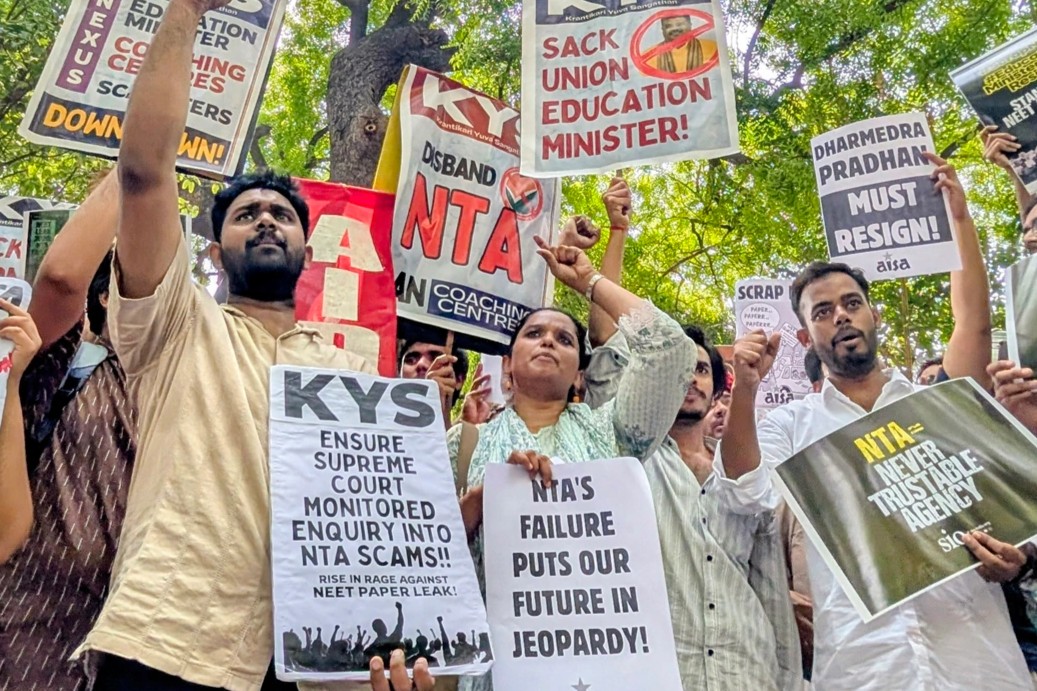
Source of the image: The Indian Express.
The NEET-UG paper leak controversy has once again placed India’s examination system under the spotlight, with questions now extending beyond the leak itself to the functioning of the National Testing Agency.
The National Testing Agency was established in 2018 after the Union Cabinet approved the creation of a specialised body to conduct entrance examinations for higher education institutions. The agency was created as an alternative to examinations previously conducted by multiple agencies, many of which had faced allegations of leaks and malpractices.
Eight years later, the agency now finds itself at the centre of another major examination controversy following the NEET-UG 2026 paper leak, which affected nearly 22 lakh candidates. The NTA has announced that the re-examination will be conducted on June 21, while the CBI has launched an investigation to determine how the leak took place despite multiple security layers in the examination process.
The handling of the NEET question paper involves several stages. Subject experts are brought in to prepare the paper in a highly controlled setting, after which the final paper is stored on an offline terminal at NTA premises. The papers are then transferred to commercial printing presses operating under CCTV surveillance and supervision. Once printed, they are moved to bank vaults and later transported to examination centres under police escort in GPS-monitored vehicles.
Despite these protocols, the system has repeatedly faced allegations of leaks. In the 2024 NEET controversy, the CBI found that question papers were allegedly photographed after trunks carrying them reached an examination centre in Jharkhand’s Hazaribagh. The papers were reportedly solved and sold to candidates. In the latest controversy, investigators traced the leak to a “guess paper” containing around 120 questions that had allegedly begun circulating weeks before the examination.
The repeated controversies have shifted attention from the examination alone to the structure and functioning of the NTA itself. Unlike the Union Public Service Commission, which derives authority from constitutional provisions, the NTA was established as a society under the Societies Registration Act, 1860. Official records show that it was registered on May 15, 2018 with a registration fee of ₹50. Although the agency functions under the Ministry of Education, it does not operate under a dedicated parliamentary statute.
The paper leak controversy has intensified scrutiny over the agency’s governance and accountability mechanisms. Questions are being raised over whether a body conducting some of India’s largest entrance examinations should continue operating through a society-based administrative structure.
Since its inception, the NTA has conducted more than 240 examinations involving over 5.4 crore candidates. Its responsibilities expanded significantly after the introduction of the Common University Entrance Test (CUET) in 2022.
Parliamentary data shows that the agency collected ₹3,512.98 crore in examination fees between 2018-19 and 2023-24, while spending ₹3,064.77 crore on conducting examinations. In its first year of operation in 2018-19, the NTA earned ₹101.51 crore in fee income while spending ₹118.43 crore. Over the following years, both revenue and expenditure increased steadily as the scale of examinations expanded.

A major jump came after the introduction of CUET. The NTA’s fee income increased from ₹490.35 crore in 2021-22 to ₹873.20 crore in 2022-23. During the same period, expenditure increased from ₹426.52 crore to ₹681.52 crore. By 2023-24, the agency’s fee income had crossed ₹1,065 crore, while expenditure stood at more than ₹1,020 crore.
Overall, the agency accumulated a surplus of around ₹448 crore during its first five years of operation. Apart from a one-time grant of ₹25 crore received at the time of its establishment, the NTA functions as a self-sustaining body funded through examination fees collected from students.
The latest NEET cancellation has also drawn attention to the scale of money involved in the examination system. With over 22.75 lakh students registered for NEET-UG 2026 and application fees ranging between ₹1,000 and ₹1,700, the agency is estimated to have collected around ₹340 crore to ₹355 crore from the examination before announcing a full fee refund.
The controversy has also revived discussion around the recommendations made by the Dr. K. Radhakrishnan Committee, which was formed in 2024 after allegations of irregularities in NEET-UG and UGC-NET examinations. The committee recommended restructuring the NTA with separate verticals for technology, security, operations, ethics and transparency.
Among its major recommendations was the creation of at least 1,000 permanent secure testing centres across the country, equipped for computer-based and hybrid examinations. The committee also proposed computer-assisted secure pen-and-paper testing, where encrypted question papers would be digitally transmitted and printed directly at examination centres instead of being physically transported over long distances.
The committee further recommended Aadhaar-linked authentication, biometric verification and AI-driven identity checks under a proposed “DIGI-EXAM” system. It also suggested increased monitoring of examination centres and the use of data analytics to identify suspicious patterns in centre allocation and candidate behaviour.
Every year, nearly 23 lakh students compete for around one lakh medical seats across the country. Government medical colleges remain the most sought-after because of their lower fee structure compared to private institutions, where fees can run into crores. The scale of competition around NEET has also led to the rapid expansion of the coaching industry over the years. For many coaching institutes, selections and ranks have become directly linked to their business and admissions for the next batch. This is one of the reasons why paper leaks and organised malpractice continue to remain a concern around high-stakes examinations like NEET.