Sunday, 20 Sep, 2026

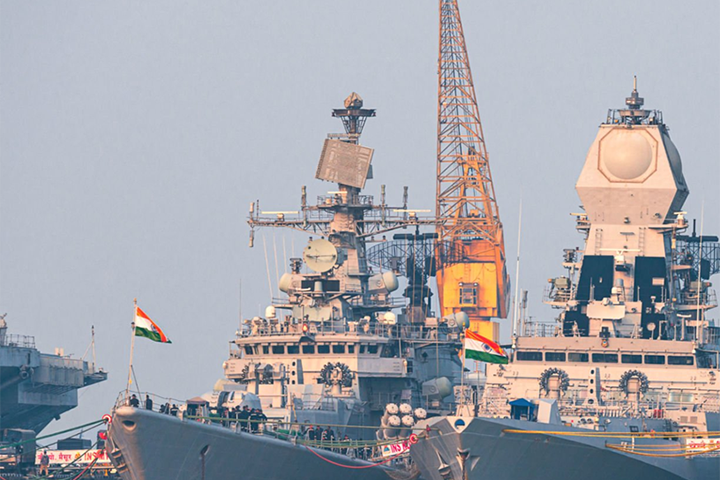
Photo courtesy: Pixabay
The naval fleet’s share of defence capital spending rose from 10.3% in 2013–14 to 18.1% in 2021–22, before dropping to 11.6% in the 2026–27 Budget Estimates
India’s maritime preparedness is once again under scrutiny as tensions rise across the Indian Ocean and the wider Indo-Pacific. Strategic rivalry among major powers is becoming more visible at sea, and naval deployments across the region are increasing. In this environment, the ability to protect sea lanes and maritime interests has become a central element of national security policy for India.
New Delhi has responded by raising spending on naval capabilities in recent years. Expenditure on the Indian Navy more than doubled from Rs 49,623 crore in 2020-21 to Rs 1,03,547 crore in 2025-26. Over the same period, the Navy’s share in the overall defence budget increased from 15 per cent to 21 per cent, according to the report of Parliament’s Standing Committee on Defence for 2024-25.
Defence spending has risen across the services, though the distribution of funds has shifted. The Indian Army’s expenditure grew from Rs 1,78,248 crore in 2020-21 to Rs 2,39,600 crore in 2025-26. However, its share in the defence budget declined from 55 per cent to 48 per cent. Spending on the Indian Air Force also increased, rising from Rs 73,244 crore to Rs 1,18,511 crore, while its share of the defence budget expanded from 22 per cent to 24 per cent.

Despite these increases, India’s naval capacity remains relatively modest compared with other major maritime powers. India currently operates roughly 130 warships. By contrast, the fleet of the People’s Liberation Army Navy exceeds 370 vessels, making it the world’s largest navy by ship numbers. The United States Navy operates close to 295 battle force ships, though its forces are deployed globally.
For India, the challenge is shaped by geography. The country sits near some of the busiest shipping routes in the world and has one of the largest exclusive economic zones. Protecting maritime trade routes, safeguarding offshore energy assets and maintaining security across a vast maritime area require sustained investment in ships, submarines and supporting infrastructure.
Capital expenditure patterns, however, show mixed signals. The share of spending on the naval fleet in total defence capital outlay rose from 10.3 per cent in 2013-14 to 18.1 per cent in 2021-22, reflecting a period when naval capability building received stronger emphasis. Yet this share later fell to 11.6 per cent in the Budget Estimates for 2026-27.
A similar pattern appears in project spending. Expenditure on naval projects increased from 0.8 per cent of defence capital outlay in 2013-14 to 3.9 per cent in 2019-20. But the share declined to 2 per cent in the 2026-27 Budget Estimates. Some variation is expected because defence procurement often involves large contracts spread over several years. Even so, these swings raise questions about the consistency of naval modernisation.
The composition of the fleet also reflects India’s operational priorities. Offshore patrol vessels account for about 29 per cent of the Navy’s fleet. These ships play a major role in coastal surveillance, maritime patrol and security operations in territorial waters. Submarines make up around 18 per cent of the fleet, while destroyers account for roughly 13 per cent.
China’s naval fleet shows broadly similar proportions in certain categories. Offshore patrol vessels represent around 31 per cent of its fleet, submarines about 18 per cent and destroyers close to 11 per cent. The difference lies in overall scale, with China operating a much larger number of vessels across categories.

Another concern relates to the pace at which naval infrastructure and related projects are completed. Since 2017, around 75 naval works and infrastructure projects have been sanctioned for the Indian Navy at a combined cost of Rs 41,469 crore. Progress has been uneven. Only three projects were completed within their scheduled timelines, while about 27 projects experienced delays. The remaining projects are still within their planned completion schedules.
These delays were highlighted in a performance audit released in December 2025 by the Comptroller and Auditor General of India titled “Works Management in the Indian Navy.” The audit examined 14 major contracts and found that 13 of them experienced delays of up to 52 months. In some instances, civil works contracts were delayed by as much as 64 months.
The report also reviewed contracts under the Annual Technical Works Programme. Nine of the 14 contracts studied required extensions ranging from 108 days to 690 days beyond their original completion deadlines. Under the Annual Major Works Programme, 15 projects were completed during the audit period, but 13 required extensions ranging from 117 to 1,367 days.
Several reasons were cited for these delays. These included late site clearances by users, changes in design, difficulties in obtaining materials and revisions in project specifications during execution.
Taken together, these trends reveal a gap between India’s maritime ambitions and the speed at which capabilities are being built. Rising defence allocations suggest that policymakers recognise the growing importance of the maritime domain. Yet financial commitments alone cannot ensure stronger naval power.
Faster project execution, smoother procurement processes and greater capacity in domestic shipbuilding will be essential if India is to translate budgetary spending into real operational strength. As competition intensifies across the Indo-Pacific, the effectiveness of India’s naval strategy will depend not just on how much is spent, but on how efficiently those resources are turned into ships, infrastructure and combat readiness.