Thursday, 17 Sep, 2026

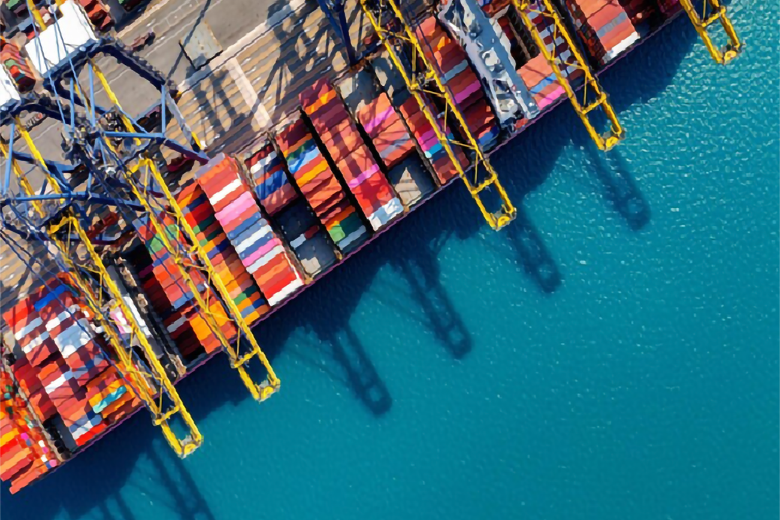
Services exports grew by an impressive 24.9 percent year-on-year to reach $39.53 billion in February, reflecting robust demand for India’s IT, business, and professional services. Image Source: IANS
The data for February 2026 further underscores the uneven nature of India’s trade performance.
India’s overall export performance during the period from April to February of the financial year 2025–26 reflects moderate growth, but a closer examination reveals underlying imbalances and pressures. Total exports, including both merchandise and services, are estimated at $790.86 billion, compared to $747.58 billion in the same period of the previous year, marking a growth of 5.79 percent. While this increase suggests a degree of resilience, it is not particularly strong when viewed against rising imports and global trade uncertainties.
Merchandise exports during this period reached $402.93 billion, only slightly higher than the $395.66 billion recorded a year earlier, translating into a modest growth of 1.84 percent. This relatively weak expansion highlights persistent challenges in India’s goods export sector, including fluctuating global demand, price volatility, and structural inefficiencies that continue to limit competitiveness.

Source: Ministry of Commerce and Industry
The data for February 2026 further underscores the uneven nature of India’s trade performance. Merchandise exports stood at $36.61 billion, showing a marginal year-on-year decline of 0.8 percent. In contrast, imports surged sharply by 24.1 percent to $63.71 billion. This steep rise in imports significantly widened the merchandise trade deficit to $27.10 billion, indicating a growing imbalance between what the country buys and sells in global markets.

Source: Ministry of Commerce and Industry
On the services side, however, the picture appears considerably stronger. Services exports grew by an impressive 24.9 percent year-on-year to reach $39.53 billion in February, reflecting robust demand for India’s IT, business, and professional services. Services imports also increased, though at a slower pace of 12.9 percent, reaching $16.38 billion. As a result, the services trade surplus expanded to $23.15 billion, providing a partial cushion against the widening merchandise deficit. Despite this support, the combined trade balance for goods and services still slipped into a deficit of $3.95 billion, compared to a surplus in the corresponding period last year, signaling a deterioration in the overall external position.
Looking at the cumulative figures for April 2025 to February 2026, total imports rose by 7.37 percent to $900.51 billion, outpacing export growth. This mismatch pushed the overall trade deficit to $109.65 billion, reflecting the stronger momentum in imports relative to exports. A significant contributor to this widening gap was the sharp increase in gold imports, which rose by 28.73 percent year-on-year, pointing to strong domestic demand. When gold imports are excluded, the trade deficit stands at $40.74 billion, indicating a more moderate but still notable increase compared to the previous year.
A detailed breakdown of imports reveals strong growth across several commodities, suggesting rising domestic consumption as well as industrial demand. Imports of silver, fertilisers, and raw cotton and waste increased significantly, driven largely by agricultural requirements and industrial use. Electronic goods and non-ferrous metals also saw steady growth, reflecting ongoing expansion in manufacturing and technology sectors. In addition, higher imports of metalliferous ores and fruits and vegetables indicate both industrial needs and consumption trends. Gold imports, although elevated, showed more moderate growth when viewed over the cumulative period.
At the same time, several import categories registered declines, indicating shifting demand patterns. Newsprint and pulses experienced sharp contractions, while imports of coal, coke, and briquettes fell significantly, suggesting reduced demand in these areas. Pulp, waste paper, and wood products also saw slight decreases. Meanwhile, imports of petroleum products, transport equipment, and iron and steel recorded only limited growth, pointing to some moderation in demand for key industrial inputs.
India’s import patterns also reflect evolving trade relationships. Imports from the United Kingdom showed the sharpest increase during this period, followed by Hong Kong, the United States, and China, highlighting stronger engagement with major global economies. China continued to remain one of the largest sources of imports, underlining India’s dependence on it for industrial and electronic goods. On the other hand, imports from Russia declined notably, while shipments from Indonesia, Australia, and Iraq also moderated. Imports from South Africa saw a significant decline over the cumulative period, despite a temporary rise in February. These shifts suggest a partial reorientation in sourcing patterns, influenced by changing demand for energy products and raw materials.
On the export front, several sectors demonstrated positive momentum in February 2026. Electronic goods emerged as a strong performer, indicating growing global demand for India’s manufacturing output in this segment. Engineering goods, pharmaceuticals, and marine products also recorded steady growth, contributing to overall export stability. Agricultural and allied sectors such as meat, dairy, poultry products, and cereals showed notable expansion, reflecting sustained demand in global food markets.
However, not all sectors performed well. Petroleum product exports recorded the sharpest decline, largely due to softer global prices and demand conditions. Other sectors such as oil meals, iron ore, and oilseeds also saw reduced exports. Additionally, products like plastics, linoleum, jute goods, and carpets experienced declines, indicating weakening demand in certain traditional export segments. The gems and jewellery sector showed only mild growth in February and registered a marginal decline over the cumulative period, further highlighting sector-specific challenges.
In terms of geographic markets, India’s exports showed improvement in several regions. Shipments to Germany, Vietnam, and Hong Kong recorded notable growth, while exports to China and Spain increased moderately. Countries such as Brazil and Belgium also showed steady expansion, reflecting diversified demand. Although exports to the United States and the United Arab Emirates moderated slightly in February, cumulative data still points to stable growth in these major markets.
At the same time, exports to certain countries declined, indicating uneven global demand. Australia, the Netherlands, and Singapore recorded significant contractions, while exports to Malaysia also decreased moderately. France presented a mixed picture, with a marginal increase in February but an overall decline during the cumulative period. These trends suggest that demand conditions in some key trading partners have weakened, affecting India’s export performance.
Overall, the data paints a picture of moderate export growth overshadowed by stronger import expansion, resulting in a widening trade deficit. While the services sector continues to provide crucial support, the relatively weak performance of merchandise exports and the rising dependence on imports raise concerns about the sustainability of India’s external trade balance.