Monday, 12 Oct, 2026

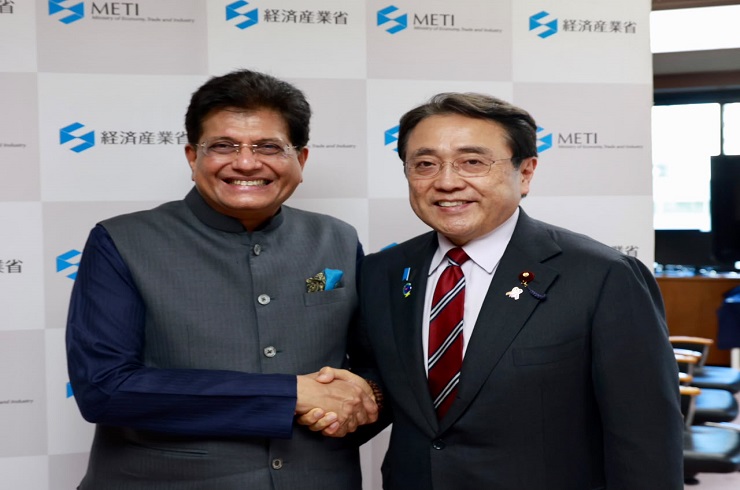
The shift towards strategic sectors is particularly visible in semiconductors and artificial intelligence. Image Source: Press Information Bureau
Bilateral trade has also expanded over the past decade, although the trade balance remains tilted towards Japan.
India-Japan economic ties are increasingly moving beyond conventional trade and investment, with the two countries placing greater emphasis on economic security, resilient supply chains, semiconductors, artificial intelligence, clean energy, defence, technology and innovation. The expanding partnership reflects a broader convergence between India’s ambitions to become a global manufacturing and technology hub and Japan’s search for reliable, diversified and resilient economic partnerships.
Union Minister for Commerce and Industry Piyush Goyal highlighted this changing character of the bilateral relationship while addressing a round-table with Keidanren, the Japan Business Federation, in Tokyo. Keidanren represents more than 1,500 leading Japanese companies and is one of the country’s most influential business organisations. Goyal called for a stronger business-to-business relationship and urged Japanese companies to substantially increase their presence and investments in India.
The Minister pointed to India’s improving ease of doing business, expanding infrastructure and rapidly growing domestic market as factors creating new opportunities for Japanese investors. He called on Japanese businesses to scale up their engagement with India and said that the number of Japanese companies operating in the country “should double this decade from current levels.”
The push comes at a time when the economic relationship is already supported by a substantial Japanese corporate presence in India. More than 1,400 Japanese companies are currently operating in the country, with major names such as Suzuki, Toyota, Honda, Sony, Hitachi and Mitsubishi having established significant operations across manufacturing, automobiles, electronics and engineering. Japanese companies have also been involved in major infrastructure projects, including the Mumbai-Ahmedabad High-Speed Rail project, while Japanese-assisted metro systems have been developed in cities such as Delhi, Ahmedabad, Bengaluru and Chennai. Eleven Japanese industrial townships across eight Indian states have further strengthened the industrial ecosystem for Japanese businesses.
Bilateral trade has also expanded over the past decade, although the trade balance remains tilted towards Japan. According to India’s Ministry of External Affairs, bilateral trade increased from around $15.3 billion in 2020-21 to $22.85 billion in 2023-24. More recently, Commerce Ministry figures indicate that India-Japan trade reached around $27.5 billion in FY 2025-26. Japan has also emerged as India’s fifth-largest source of foreign direct investment, underlining the importance of Japanese capital to India’s manufacturing and infrastructure ambitions.

Source: Embassy of India, Tokyo Japan
Japan’s long-term confidence in India’s growth prospects is particularly significant. A 2024 survey by the Japan Bank for International Cooperation ranked India as the most promising country for Japanese companies over the medium term for the 15th consecutive year. India also retained the top position in the long-term category, with companies identifying the growth potential of the Indian market as a major attraction. Japanese outward investment into India has risen sharply in recent years, reaching $3.1 billion in FY 2023-24, compared with $1.79 billion the previous year.
The investment relationship is now also being given a new long-term target. During the 16th India-Japan Annual Summit in July 2026, the two countries reaffirmed their ambition to strengthen Japanese private investment in India, with the current target set at 10 trillion yen over the next decade. This builds on the earlier 5-trillion-yen public and private investment and financing target announced during former Japanese Prime Minister Fumio Kishida’s visit to India in March 2022.
The shift towards strategic sectors is particularly visible in semiconductors and artificial intelligence. During his Tokyo visit, Goyal held discussions with the leadership of Sumitomo Corporation, Meiji Seika Pharma, Mitsubishi Corporation, Tokyo Electron and MinebeaMitsumi on expanding their operations and investments in India. His meetings with Tokyo Electron and MinebeaMitsumi were especially significant given the growing importance of semiconductor manufacturing in the bilateral economic relationship.
The engagement with Tokyo Electron, a major global semiconductor equipment manufacturer, and MinebeaMitsumi, which is overseeing a semiconductor plant project in India, reflects the increasing effort to integrate Japanese technological capabilities with India’s manufacturing ecosystem. Goyal also chaired an India-Japan industry round-table focused specifically on semiconductors and AI, describing the two sectors as emerging pillars of the countries’ economic security partnership.
The focus on economic security is part of a broader strategic recalibration in the India-Japan relationship. At the 16th Annual Summit, the two governments adopted a Joint Declaration on Economic Security that identified semiconductors, critical minerals, information and communication technology, artificial intelligence, clean energy and pharmaceuticals as areas for project-based cooperation. The two sides also agreed to strengthen cooperation on batteries and energy resilience, including strategic stockpiling and collaboration across the maritime energy supply chain.
Supply-chain resilience has consequently become one of the most important bridges between the economic and strategic dimensions of the partnership. Through initiatives such as the India-Japan Industrial Competitiveness Partnership, both countries have sought to diversify and strengthen supply chains while encouraging greater participation by Japanese companies in India. For Japan, India offers a large and rapidly expanding market as well as an alternative manufacturing and supply-chain base. For India, Japanese technology, capital and manufacturing expertise can support efforts to move up global value chains and strengthen domestic industrial capabilities.
Clean energy represents another expanding area of cooperation. India and Japan have been working together on hydrogen, ammonia, LNG and other areas linked to energy security and decarbonisation. The latest summit-level discussions have widened this cooperation to batteries, biogas and other clean-energy technologies, reflecting the growing importance of energy resilience alongside the transition towards low-carbon economies.
Infrastructure remains another enduring pillar of the relationship. Japanese development assistance has played a major role in India's transport and urban infrastructure, while projects such as the Mumbai-Ahmedabad High-Speed Rail and the Western Dedicated Freight Corridor have demonstrated how Japanese financing, technology and project-management capabilities can complement India's infrastructure expansion. The partnership is therefore increasingly extending from individual projects towards the development of broader industrial and logistics ecosystems.
The two countries are also seeking to make their economic relationship more responsive to emerging opportunities. During Goyal’s meeting with Japan’s Minister of Economy, Trade and Industry on August 25, the two sides agreed on the need to accelerate the review of the India-Japan Comprehensive Economic Partnership Agreement (CEPA), with the objective of making it more forward-looking and better aligned with new areas of economic cooperation. Discussions covered next-generation industries, manufacturing, technology, innovation, trade and investment.
Japanese financial institutions are also showing sustained interest in India’s growth story. During his Tokyo visit, Goyal met senior representatives from MUFG, Development Bank of Japan, Mizuho, Morgan Stanley, Nomura and Nippon Life to discuss long-term capital flows and greater Japanese institutional investment in India. The discussions focused on investment opportunities in areas including semiconductors, AI, clean energy and digital infrastructure, while Japanese institutions highlighted the importance of facilitating capital flows and profit repatriation.
The scale of the latest economic engagement itself reflects the growing importance attached to the partnership. Goyal’s four-day visit to Japan from August 24 to 27, 2026, is being accompanied by more than 200 Indian business representatives from sectors including manufacturing, semiconductors, clean energy, steel, automobiles, financial services, healthcare and start-ups, making it India’s largest-ever business delegation to Japan.
The broader strategic relationship is also being reinforced at the political level. The two countries have described their ties as a Special Strategic and Global Partnership and share a common interest in maintaining a free, open, peaceful and rules-based Indo-Pacific. Their cooperation has consequently expanded into areas such as defence, maritime security, cyber, space and emerging technologies, creating a wider strategic framework within which economic cooperation can develop. The India-Japan Joint Vision for the Next Decade adopted in 2025 further identified multiple areas for expanding cooperation and bringing the two economies and societies closer together.
People-to-people ties are also expected to receive greater attention as the partnership enters a new phase. India and Japan have designated 2027 as the India-Japan Year of Shared Horizons to commemorate the 75th anniversary of the establishment of diplomatic relations. The year-long programme is expected to strengthen cooperation in culture, tourism, the creative economy and people-to-people exchanges.
Taken together, these developments suggest that India-Japan economic relations are evolving from a largely trade-and-investment relationship into a broader strategic economic partnership. Japanese capital and technology can support India’s ambitions in advanced manufacturing, semiconductors, clean energy and next-generation infrastructure, while India’s expanding market, workforce and manufacturing capabilities offer Japanese companies opportunities to diversify production and establish new global supply chains.
The challenge now will be to convert the growing political convergence and investment commitments into projects on the ground. Faster implementation, a predictable business environment, stronger supply-chain linkages, improved market access and closer industry-to-industry engagement will be crucial to sustaining momentum. If these elements come together, the India-Japan partnership could become an important component of both countries’ economic resilience strategies and a key pillar of a more diversified and technologically capable Indo-Pacific economy.