Sunday, 25 Oct, 2026

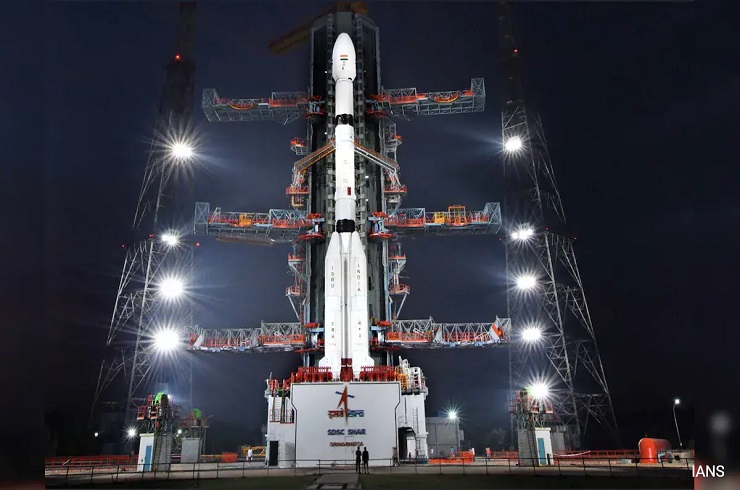
Once fully operational, EOS-05 will become India’s first dedicated imaging satellite operating from geostationary orbit. Image Source: IANS
The successful deployment of EOS-05 comes after the failure of the EOS-03 mission aboard GSLV-F10 in 2021 and follows the setbacks involving the PSLV-C62/EOS-N1 mission in May 2025.
The Indian Space Research Organisation (ISRO) has achieved a significant milestone in India’s space programme with the successful launch of the advanced Earth Observation Satellite, EOS-05, aboard the Geosynchronous Satellite Launch Vehicle (GSLV) Mk II-F17. The launch, carried out in the early hours of Friday from the Satish Dhawan Space Centre (SDSC) in Sriharikota, marks the first time India has placed a dedicated imaging satellite in a high-altitude geostationary orbit of around 36,000 km.
The mission is particularly significant for the GSLV programme, which has faced setbacks in recent years. The successful deployment of EOS-05 comes after the failure of the EOS-03 mission aboard GSLV-F10 in 2021 and follows the setbacks involving the PSLV-C62/EOS-N1 mission in May 2025 and PSLV-C61/EOS-09 mission in January 2026. Against this backdrop, the success of GSLV-F17 provides an important boost to the reliability and credibility of India’s heavier-lift launch capabilities.
Liftoff took place at 2:55 am from the second launchpad at Sriharikota amid light rainfall. Weighing 2,367 kg, EOS-05 is the heaviest satellite ever placed into orbit by the GSLV Mk II. The mission also marked the 107th launch from the Sriharikota spaceport and the 19th flight of the GSLV.
Following the completion of the planned orbit-raising manoeuvres, EOS-05 is expected to be positioned above the South Asian landmass at an inclination of 19.28 degrees to the equator. Its geosynchronous configuration will allow it to maintain a fixed position relative to a particular region of the Earth as it travels around the planet at the same rate at which the Earth rotates.
This represents a major shift in the way India can use space-based Earth observation. Conventional Earth observation satellites operating in low Earth orbit periodically pass over the same locations, leaving gaps between observations. EOS-05, by contrast, will be able to maintain an almost continuous watch over the Indian landmass and neighbouring regions. This capability could prove particularly valuable for monitoring rapidly evolving events where even a short delay can affect the quality of response.
Once fully operational, EOS-05 will become India’s first dedicated imaging satellite operating from geostationary orbit. ISRO Chairman V Narayanan described the spacecraft as a “strategic satellite” capable of providing important data for a range of national applications. Its advanced imaging systems will support weather monitoring, agricultural assessment and the tracking of fast-moving disasters such as cyclones, floods and cloudbursts.
The satellite’s multi-spectral and hyper-spectral imaging capabilities are expected to significantly enhance the quality and frequency of Earth observation. It can capture images of selected areas at intervals of around five minutes while covering the entire country approximately every 30 minutes. Such high-frequency observations could strengthen India’s ability to track weather systems, assess damage during disasters and monitor changes in agricultural and environmental conditions in near real time.
The satellite has an assured mission life of seven years. However, Narayanan expressed confidence that EOS-05 could remain operational for more than nine years, potentially allowing India to derive long-term benefits from the mission. He described the launch as particularly important for maintaining continuous observation of India and its surrounding areas and highlighted the spacecraft’s advanced cameras and other payloads.
The strategic character of the satellite has also generated speculation about possible security applications. While Narayanan referred to EOS-05 as a strategic satellite, he rejected suggestions that it was a dedicated spy satellite. He did not elaborate on what he meant by its potential “other Earth observation purposes”, leaving the broader scope of its applications open to interpretation.
According to Project Director (Satellite) Imteyaz Ahamad, EOS-05 is a unique spacecraft because of its multi-band operating capabilities and a configuration different from conventional Earth observation satellites. Dinesh Kumar Singh, Director of the UR Rao Satellite Centre, meanwhile described the spacecraft as an “Eye in the Sky” and said that the satellite was in good health following the launch and that all initial operations had been successfully completed.
The tense atmosphere at Sriharikota gradually turned into celebration as the mission progressed. Cheers erupted among ISRO scientists around 3:01 am as separation of the third-stage cryogenic upper-stage engine began, followed by further celebrations after the cryogenic upper stage reported normal thrusting at around 3:10 am. The biggest moment of relief came around 3:14 am when the cryogenic upper-stage valves were shut off and EOS-05 was successfully separated from the launch vehicle.
Announcing the success, Narayanan said that GSLV-F17 had successfully and precisely injected the advanced EOS-05 geo-imaging satellite into its intended orbit. The successful mission therefore represents more than another launch for ISRO. It restores confidence in the GSLV Mk II following recent failures and demonstrates India's growing ability to deploy sophisticated, heavy Earth observation platforms into higher orbits.
The mission also comes at a time when India is seeking to expand its space capabilities across Earth observation, communications, scientific research, launch vehicles and human spaceflight. The Union Budget for 2026-27 has allocated Rs 13,705.63 crore to the Department of Space, an increase of around Rs 289 crore, or just over 2 per cent, from the 2025-26 Budget Estimate of Rs 13,416.20 crore.
While the increase is relatively modest, the composition of the allocation provides some indication of the government’s priorities. Capital expenditure has risen from Rs 6,103.63 crore in 2025-26 to Rs 6,375.92 crore in 2026-27, an increase of more than Rs 270 crore. Revenue expenditure, covering salaries, routine operations and other recurring costs, has remained broadly stable at Rs 7,329.71 crore.
The relatively greater emphasis on capital expenditure points towards continued investment in long-term space infrastructure and technological capabilities. A substantial portion of the space budget is directed towards space technology, encompassing launch vehicle development, satellite programmes, infrastructure at ISRO centres and human spaceflight initiatives. Allocations for space applications and space sciences have also increased, supporting areas such as Earth observation, communications, scientific research and the development of applications based on space-derived data.
The successful EOS-05 mission therefore comes at an important juncture for India’s space ambitions. On one hand, it demonstrates ISRO’s ability to recover from recent launch failures and deploy increasingly sophisticated satellites into demanding orbits. On the other, its near-continuous imaging capability could provide a new layer of intelligence for weather forecasting, disaster management, agriculture and environmental monitoring.
With India simultaneously pursuing more ambitious launch vehicles, human spaceflight and advanced satellite missions, the success of GSLV-F17 could prove significant beyond the immediate achievement of placing EOS-05 in orbit. It strengthens the foundation for a space programme increasingly focused not merely on reaching orbit, but on building persistent, high-value space-based capabilities that can serve economic, scientific, environmental and strategic objectives.