Friday, 16 Oct, 2026

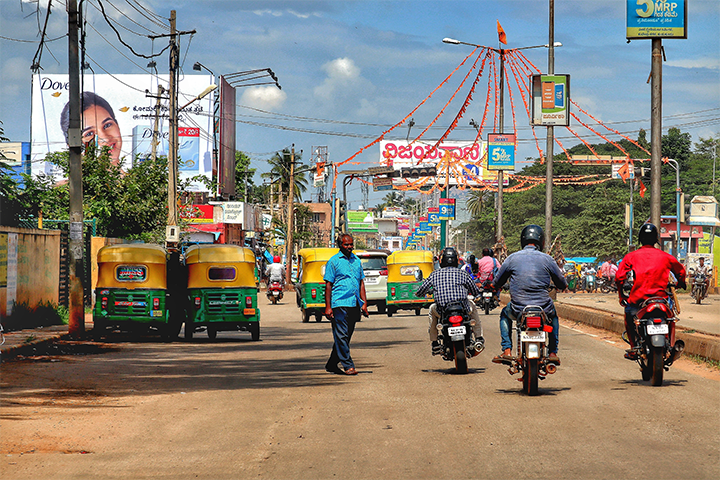
The real significance lies not in who tops the sales table, but in what it represents: Indian manufacturers are steadily building a stronger presence in global markets, making exports a more durable driver of economic growth.
Photo courtesy: Pixabay
The two-wheeler industry has quietly reached a turning point. At first glance, the story is about one company overtaking another. But that misses the larger change. What happened in June 2026 shows that India’s motorcycle makers are no longer growing only because Indians are buying more bikes. They are increasingly growing because the rest of the developing world is buying Indian-made motorcycles and scooters.
TVS Motor Company became India’s largest two-wheeler manufacturer by total global sales in June, selling 565,417 units. It moved ahead of Hero MotoCorp, which sold 541,000 units, and Honda Motorcycle & Scooter India (HMSI), which sold 528,000 units. The victory was not narrow. TVS outsold Hero by around 24,000 units and Honda by about 37,000 units. Yet the more important question is not by how much it won, but why.
The answer is exports.
TVS exported around 154,000 two-wheelers during the month, almost 2.9 times the combined export volumes of Hero MotoCorp and HMSI. Strong demand from Africa, Latin America, Asean and West Asia helped the company pull ahead of its competitors.

The company’s overall performance was equally impressive. Total two-wheeler sales jumped 47 per cent from 385,698 units in June 2025 to 565,417 units in June 2026. Domestic two-wheeler sales increased 46 per cent, rising from 281,012 units to 411,014 units. Motorcycle sales grew 42 per cent from 188,774 units to 267,096 units, while scooter sales climbed an even faster 53 per cent, from 162,291 units to 247,950 units.
But the real story extends well beyond TVS.
June showed that exports have become the strongest source of growth for India’s two-wheeler industry. Bajaj Auto’s exports rose 49 per cent, TVS Motor's increased 48 per cent, Honda Motorcycle & Scooter India’s grew 47 per cent, Hero MotoCorp’s climbed 33 per cent, and Suzuki Motorcycle India's rose 12 per cent. Royal Enfield was the only major manufacturer to move in the opposite direction, with exports falling 12 per cent.
The trend becomes even clearer when looking at the first quarter of FY27. Hero MotoCorp's exports surged 63.3 per cent, Bajaj Auto’s increased 52 per cent, HMSI's grew 36 per cent, TVS Motor's international business expanded 33 per cent, and Suzuki Motorcycle India's exports rose 8.9 per cent. Once again, Royal Enfield stood apart, with exports declining 20 per cent.
Domestic demand remained healthy, but it grew more slowly than exports for most manufacturers. During April-June, Royal Enfield’s domestic sales rose 31.6 per cent, Hero MotoCorp's increased 20.7 per cent, HMSI’s grew 15 per cent, Bajaj Auto’s rose 10.8 per cent, and Suzuki Motorcycle India’s increased 8.1 per cent. Domestic sales are still much larger than export volumes, but overseas markets are now contributing a larger share of incremental growth.

This is an important economic shift.
For many years, India’s two-wheeler industry depended almost entirely on domestic demand. Rising incomes, expanding rural markets and easier access to finance made India the world's largest motorcycle market. That remains true. But today's fastest growth is increasingly coming from countries that resemble India a decade or two ago—economies where affordable personal transport is becoming essential as incomes rise.
Worth mentioning here is that Indian manufacturers are becoming less dependent on the Indian economy alone. If rural demand weakens or financing becomes tighter at home, companies with strong overseas businesses have another source of growth.
More significantly, every motorcycle sold overseas earns foreign exchange. India continues to import large quantities of crude oil and runs a sizeable merchandise trade deficit. Successful manufacturing exports cannot eliminate that problem, but they help reduce the imbalance by bringing more export earnings into the country.
Experts say a company proves its strength not by dominating its home market alone but by winning customers abroad against global rivals. Indian two-wheeler manufacturers are increasingly doing exactly that.
It would be easy to see June’s sales figures simply as a contest between TVS, Hero and Honda. That would be the wrong conclusion. Leadership positions change over time. What matters more is that India's two-wheeler manufacturers are becoming global companies rather than businesses that depend almost entirely on Indian consumers.
The significance of TVS becoming number one therefore lies not only in the ranking itself, but in what it represents. Indian companies are beginning to compete successfully across the developing world. That is good for the companies, good for manufacturing and, ultimately, good for the Indian economy. In the long run, that may prove to be a far more important achievement than finishing first in a single month’s sales table.