Friday, 16 Oct, 2026

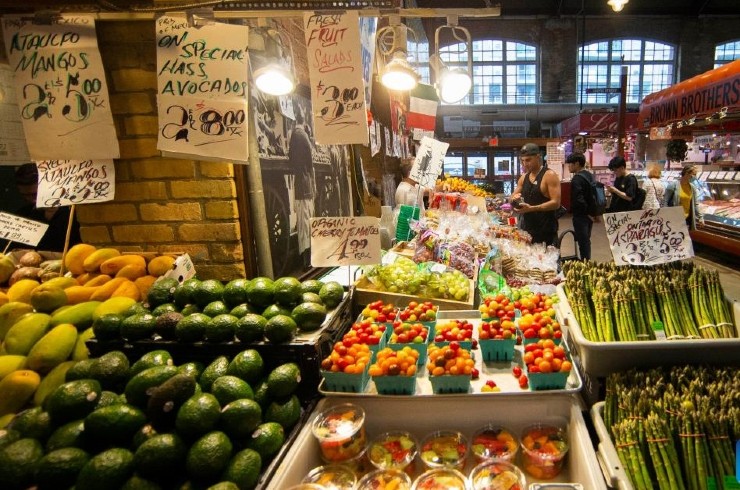
Food inflation, measured by the Consumer Food Price Index (CFPI), rose to 5.52 percent in July from 5.32 percent in June. Image Source: IANS
The July inflation data comes after the RBI’s Monetary Policy Committee, at its August 5 meeting, trimmed its inflation forecast for FY27 to 5 percent from 5.1 percent projected in June.
India’s retail inflation rose to 4.45 percent in July from 4.38 percent in June, as higher food prices continued to put pressure on household budgets, according to data released by the government. The latest Consumer Price Index (CPI) reading remained above the Reserve Bank of India’s (RBI) medium-term inflation target of 4 percent, after inflation crossed the target in June following a prolonged period of subdued price growth.
The RBI is mandated to maintain headline retail inflation at 4 percent, while allowing it to move within a tolerance band of 2 percent to 6 percent, for the five-year period from April 1, 2026, to March 31, 2031. July’s inflation reading was also the highest recorded since India introduced its revised CPI series with a new base year and an updated consumption basket earlier this year. The increase was broadly in line with market expectations. A Reuters poll of 40 economists conducted between August 5 and 7 had forecast retail inflation to rise to 4.50 percent in July from 4.38 percent in June.

Source: Ministry of Statistics and Programme Implementation
"Inflation came in line with expectations. We continue to monitor the pace of rainfall and reservoir levels along with trend in crude oil prices and pass through of higher input prices. While core inflation remains benign for now, headline inflation is expected to trend higher above 5 percent from 3QFY27. We thus continue to see room for 50bp of rate hikes by the MPC in 2HFY27," Upasna Bhardwaj, Chief Economist, Kotak Mahindra Bank, said.
Food inflation, measured by the Consumer Food Price Index (CFPI), rose to 5.52 percent in July from 5.32 percent in June. Rural food inflation stood at 5.79 percent, while urban food inflation was lower at 5.05 percent. The increase in food inflation was driven by sharp price increases in several key food items. Inflation in onions rose to 22.54 percent in July from 4.73 percent in June, while garlic inflation climbed to 35.36 percent from 17.93 percent. Ginger inflation accelerated sharply to 83.62 percent from 50.41 percent in June. However, prices of several vegetables continued to decline, providing some relief to consumers. Potato prices fell 16.56 percent year-on-year in July, compared with a 20.34 percent decline in June. Lady’s finger inflation turned negative at 5.52 percent, compared with 5.54 percent inflation in June, while peas and tomatoes recorded deflation of 5.27 percent and 4.59 percent, respectively.
Price pressures were also visible across several non-food categories. Transport inflation accelerated to 4.43 percent in July from 4.31 percent in June, while inflation in transport services for goods stood at 7.77 percent, compared with 7.70 percent in June. Housing inflation stood at 2.22 percent in July, with rural housing inflation at 2.80 percent and urban housing inflation at 2.01 percent. Inflation in restaurants and accommodation services stood at 7.72 percent, while clothing and footwear inflation was recorded at 3.38 percent.
Inflation in personal care, social protection and miscellaneous goods and services remained particularly high at 14.77 percent, driven in part by sharply higher prices for other personal effects, which recorded inflation of 43.54 percent. Inflation in health stood at 1.34 percent, while education services inflation was 3.64 percent.
The July inflation data comes after the RBI’s Monetary Policy Committee, at its August 5 meeting, trimmed its inflation forecast for FY27 to 5 percent from 5.1 percent projected in June. The central bank cited recent softening in global crude oil prices and easing supply-side pressures as factors behind the downward revision. Quarter-wise, the RBI expects inflation at 4.1 percent in Q1 FY27, down from its earlier estimate of 4.2 percent, and at 4.7 percent in Q2, revised from 5.1 percent. Its projection for Q3 was retained at 5.9 percent, while the Q4 forecast was raised marginally to 5.5 percent from 5.4 percent.
The central bank said risks to the inflation outlook remain evenly balanced, with headline inflation expected to peak in the third quarter before moderating thereafter. The RBI also lowered its FY27 core inflation forecast to 4.3 percent from 4.7 percent projected earlier.
"The realised inflation for the first quarter, however, was marginally lower than projections, reflecting limited pass-through of cost pressures. The higher inflation is largely on account of food and fuel prices, with little sign of generalisation of price pressures so far."
Debopam Chaudhuri, Chief Economist, Piramal Group, said, “inflationary pressures in India remain broadly contained despite elevated wholesale price inflation driven by a weaker rupee and higher energy costs. This stands in contrast to several major economies, including the US, where inflation continues to remain well above central bank comfort levels. The relatively benign inflation outlook should provide the RBI with additional room to maintain the policy rate at its October meeting. "The rise in retail inflation during July was largely driven by anticipated supply-side factors, including tomatoes and onions, transport costs, cooking fuel and restaurant prices. These appear to be transitory in nature rather than reflective of stronger underlying demand."
"If geopolitical tensions in West Asia continue to ease over the coming weeks, there is a reasonable probability that retail inflation could undershoot the RBI's projected peak of 5.9 percent for the December 2026 quarter. Such an outcome would support a more favourable interest rate environment, helping sustain consumer demand while also improving the viability of leveraged private sector capex," Chaudhuri added.
With food prices remaining the key driver of the latest increase, the trajectory of inflation in the coming months will depend closely on rainfall, reservoir levels, agricultural supplies and global commodity prices. The movement of crude oil prices and the extent to which higher input costs are passed on to consumers will also remain important factors for the inflation outlook.