Monday, 05 Oct, 2026

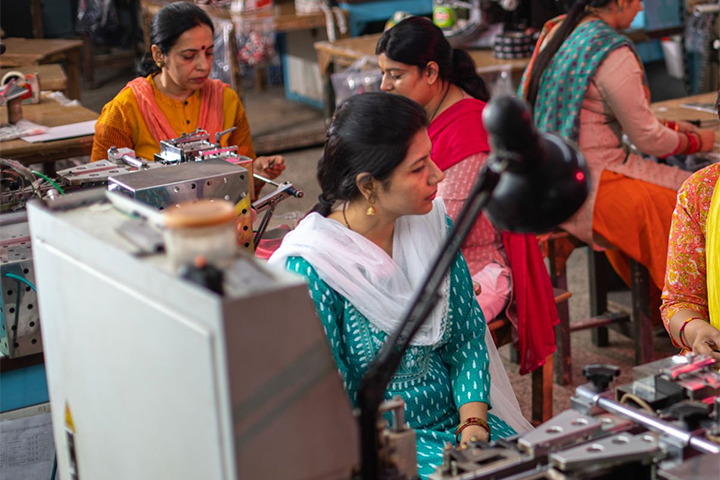
Photo courtesy: Pixabay
The data also reveal what remains unresolved: factory jobs and output are concentrated, while wages per worker are rising more slowly than the overall wage bill
India’s organised manufacturing sector has crossed an important threshold. Employment in registered factories rose 7.2 per cent in 2024-25, adding 14.1 lakh people and taking the number of persons engaged above 2 crore for the first time.
The longer-term change is more significant. Since the pandemic-hit 2020-21, factory employment has increased by about 4.9 million, or 30.5 per cent, from 1.6 crore. For an economy where the central question has often been whether industrial growth is creating enough jobs, this is a useful shift.
But the employment increase needs to be seen alongside production. Factory output rose 7.8 per cent in FY25 to Rs 165.24 lakh crore, compared with 5.8 per cent growth a year earlier. Gross value added increased 9.6 per cent to Rs 26.94 lakh crore, although this was slower than the 11.9 per cent rise in FY24.
So this was not a case of factories employing more people while production was broadly flat. Output growth accelerated and employment grew with it. The Ministry of Statistics and Programme Implementation said most major indicators of the registered manufacturing sector—invested capital, inputs, output, GVA, employment and wages—increased during the year.
There is a further point in the employment numbers. About 80 per cent of the 14.1 lakh increase in total persons engaged came from workers. The National Statistics Office defines workers as those employed directly or through an agency in the manufacturing process or in work connected with it. The balance came from other categories of employees and persons engaged, including supervisory and managerial staff.
This suggests that much of the expansion was in jobs connected directly with production, rather than simply in the supervisory and administrative layers.
The wage figures, however, are less striking.

The total wage bill rose 12.1 per cent in FY25, marginally faster than the 11.9 per cent increase in FY24. Average wages per worker rose 5.3 per cent to about Rs 2.28 lakh a year, compared with a 5.5 per cent increase in FY24. Emoluments per person engaged rose 4.6 per cent to Rs 3.82 lakh.
The distinction is important. The total wage bill is rising quickly because the number of workers is rising. Individual pay is increasing much more slowly. For the wider economy, it is the latter that matters more directly for household incomes and consumption.
The geographical spread of factory employment also remains narrow.
Tamil Nadu continues to be the largest employer in manufacturing, although its share of national factory employment fell to 14.99 per cent in FY25 from 15.24 per cent in FY24. Together, Tamil Nadu, Maharashtra, Gujarat, Uttar Pradesh and Haryana accounted for about 56 per cent of manufacturing employment.
This reflects the strength of India’s established manufacturing centres. It also points to the limits of the current industrial geography. A larger employment contribution from manufacturing will require investment to spread beyond these states, along with the infrastructure, skills, logistics and supplier networks that factories need.
The industry pattern is somewhat more diversified.
Food products remained the largest employer, with 23.6 lakh people, accounting for 11.2 per cent of total manufacturing employment. Textiles employed 17.6 lakh, basic metals 15.8 lakh, motor vehicles 14.8 lakh and wearing apparel 14.6 lakh.
These numbers show the continuing importance of labour-intensive industries. Food, textiles and apparel together provide a large pool of factory employment, even as metals and automobiles occupy an important place in the industrial structure.
The production side remains more concentrated. Basic metals, food products, coke and refined petroleum products, motor vehicles and chemicals were the five largest industries by output in FY25, unchanged from FY24. Together they accounted for 54.2 per cent of total manufacturing output.
Their combined share was nevertheless down from 56.5 per cent a year earlier. That is not a dramatic change, but it points towards a slightly broader distribution of output.
There is an important limitation to the employment numbers. The Annual Survey of Industries (ASI) covers factories registered under the Factories Act, 1948, along with bidi and cigar units, some electricity undertakings and larger establishments listed in state business registers. It does not cover the large unorganised manufacturing sector.

The 2 crore figure, therefore, is not the size of India’s manufacturing workforce. It is the employment count for the registered factory sector. That distinction is essential when assessing the overall jobs picture.
The ASI nevertheless provides an important measure of industrial change because it brings together employment, wages, output, GVA, capital formation and other indicators. Its results feed into national and state-level accounts.
The FY25 survey covers 86,547 units, with fieldwork carried out between October 2025 and June this year.
The broad message is that organised manufacturing is now generating a more visible employment response to rising production. That is important. An economy cannot rely indefinitely on output growth that does not translate into work.
But the numbers also show what remains unresolved. Factory employment is concentrated in a handful of states; output is concentrated in a handful of industries; and the rise in individual wages is much slower than the increase in the overall wage bill.
Crossing 2 crore factory jobs is therefore a useful milestone, but not evidence that India has solved its industrial employment problem. The real test is whether manufacturing can generate many more jobs, in more parts of the country, while raising the earnings attached to them.