Friday, 16 Oct, 2026


Photo courtesy: Pixabay
Passenger vehicle sales rose 26.6% year on year to 379,671 units in December, driven by a sharp 32.4% surge in rural demand that outpaced growth in urban markets
The automobile market clocked a robust performance in 2025, but the momentum did not come from the familiar engines of big cities. Instead, it was the countryside—villages, small towns and agrarian belts—that emerged as the unexpected driver of growth, signalling a deeper change in how and where personal mobility is spreading across the country.
Rural markets outperformed urban centres in passenger vehicle sales last year, expanding by 12 per cent compared with 8 per cent growth in cities, according to data released by the Federation of Automobile Dealers Associations (FADA). The divergence marks a departure from a decade-long trend where metro demand dictated the pace of India’s auto industry.
Total passenger vehicle sales rose to 44.7 lakh units in 2025, up from 41 lakh units the previous year. Across segments, the auto retail sector posted its highest-ever annual volumes, with total retail sales touching nearly 2.82 crore units—an increase of 7.71 per cent year-on-year.
While the headline numbers suggest a healthy recovery, the more telling story lies beneath: growth was increasingly broad-based and geographically dispersed.
Rural India steps on the accelerator
December offered a sharp snapshot of the changing dynamics. Passenger vehicle sales jumped 26.64 per cent year-on-year to 379,671 units, compared with 299,799 units in December 2024. Rural demand surged by 32.4 per cent during the month, comfortably outpacing urban growth.
“The harvest season was good, followed by a favourable monsoon. Minimum support prices announced by the government also supported rural purchasing,” said CS Vigneshwar, president of FADA.
Policy factors played a crucial role. GST rationalisation, revised income-tax slabs and four rate cuts by the Reserve Bank of India through the year lowered the cost of ownership. These measures had a stronger impact outside major cities, where buyers are more sensitive to monthly instalments and upfront costs.
FADA defines rural markets as regions where more than 40 per cent of the population depends on agriculture. Dealers say demand from these areas is no longer restricted to entry-level models. Rising aspirations, deeper penetration of organised finance and better road connectivity are encouraging first-time buyers as well as upgrades.
Recovery spreads across segments
The revival was not limited to passenger vehicles. Two-wheeler sales grew 7.24 per cent in 2025, commercial vehicles expanded by 6.71 per cent, and tractor sales rose a strong 11.52 per cent, reflecting buoyant farm sentiment and steady infrastructure activity.

Overall urban retail sales grew by 8.2 per cent during the year, while rural markets expanded by 7.31 per cent. Within passenger vehicles, however, rural demand stood out, growing 12.31 per cent compared with 8.08 per cent in urban areas—highlighting the widening reach of personal mobility beyond metropolitan centres.
Yet the year was not without its soft patches.
A year divided
The first eight months of 2025 remained subdued despite supportive macroeconomic cues. Direct tax relief announced in the Union Budget and cumulative rate cuts by the RBI did little to lift sentiment immediately.
The inflection point came in September, following the rollout of GST 2.0 rate rationalisation. Tax reductions for mass-market segments—including small cars, two-wheelers up to 350cc, three-wheelers and key commercial vehicle categories—improved affordability and boosted buyer confidence.
From September to December, showroom footfalls rose sharply, culminating in a strong year-end. Auto retail volumes touched 20.3 lakh units in December alone, marking a 14.63 per cent increase year-on-year. Year-end discounts and advance buying ahead of anticipated January price hikes further supported sales.
Cleaner fuels reshape choices
Another defining trend was the shift in fuel preferences. Nearly one-third of all passenger vehicles sold in 2025 ran on alternative fuels such as compressed natural gas (CNG), hybrids and electric powertrains.
The share of CNG vehicles increased to 21 per cent from 18 per cent a year earlier. Electric vehicles doubled their share to 4 per cent from 2.4 per cent, while hybrids slipped marginally to 8.2 per cent from 8.7 per cent. Petrol-powered vehicles accounted for 49 per cent of sales, down from 52 per cent in 2024, while diesel remained unchanged at 18 per cent.
In the two-wheeler segment, electric vehicles continued to gain ground, accounting for 7.4 per cent of sales, up from 6.13 per cent last year, driven largely by stronger urban demand and improved liquidity.
Beyond the metros
The data underline a clear shift. India’s auto boom is no longer confined to cities. Rising rural incomes, supportive policies and expanding credit access are pushing vehicle ownership deeper into the hinterland.
For manufacturers and dealers, future growth will hinge as much on small towns and villages as on urban markets. For policymakers, the trend suggests that affordability-focused reforms are translating into tangible demand.
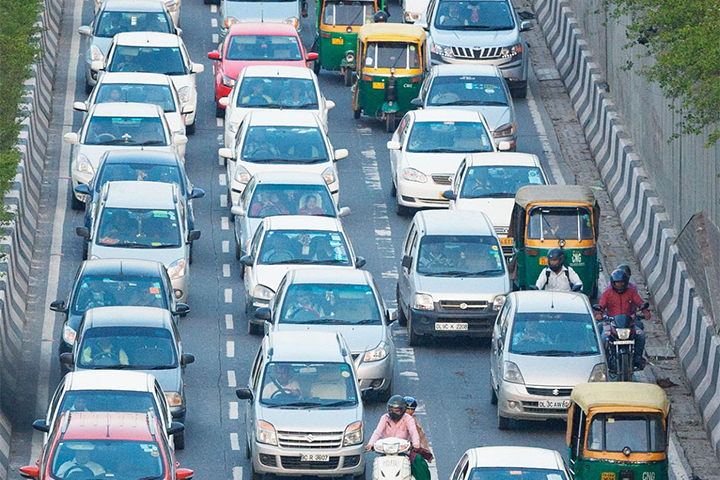
India’s roads are getting busier—but increasingly, the traffic is coming from far beyond the metros.