Friday, 16 Oct, 2026


The proposed agreement is also expected to unlock new growth avenues in a number of priority sectors, including agriculture, food processing, renewable energy, pharmaceuticals, education, and services, areas where both nations see considerable potential for collaboration. Image Source: Getty Images
According to the Ministry of Commerce and Industry, the discussions reflected the two nations’ shared vision of creating a comprehensive, modern, and mutually beneficial trade partnership.
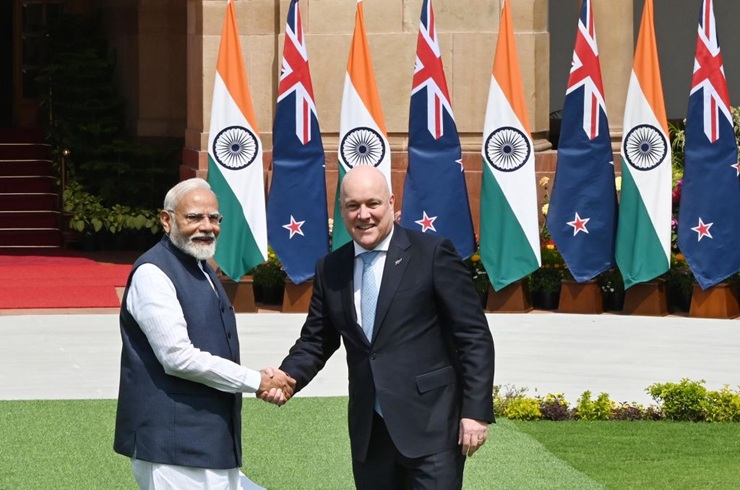
India and New Zealand have successfully concluded the fourth round of negotiations for a Free Trade Agreement (FTA), marking another step forward in their efforts to strengthen economic ties. The five-day negotiation round, described by both sides as constructive and forward-looking, covered a wide range of key issues including trade in goods and services, rules of origin, and broader economic cooperation. According to the Ministry of Commerce and Industry, the discussions reflected the two nations’ shared vision of creating a comprehensive, modern, and mutually beneficial trade partnership. Both countries expressed optimism over the progress achieved so far and reaffirmed their commitment to maintaining the current momentum.
In a joint statement, India’s Union Minister of Commerce and Industry, Piyush Goyal, and New Zealand’s Minister for Trade and Investment, Todd McClay, welcomed the steady advancement of negotiations. They noted that a well-balanced FTA would significantly enhance bilateral trade and investment flows, improve supply chain resilience, and expand market access for businesses on both sides.
The proposed agreement is also expected to unlock new growth avenues in a number of priority sectors, including agriculture, food processing, renewable energy, pharmaceuticals, education, and services, areas where both nations see considerable potential for collaboration. To ensure continuous progress, both sides have agreed to hold inter-sessional consultations and technical meetings before the next formal negotiation round. They reiterated their intention to finalize the FTA at the earliest possible date, ensuring that the final framework delivers tangible benefits to both economies.
The current round of negotiations builds upon the formal launch of the FTA process on March 16, 2025, when Minister Goyal met Minister McClay to set in motion a fast-tracked dialogue. That initial meeting underscored a joint determination to move swiftly towards a comprehensive trade pact that would deepen the India–New Zealand economic relationship and create new opportunities for trade diversification and investment partnership.
India and New Zealand have long maintained warm and friendly relations, underpinned by shared values and historical ties. Both countries are members of the Commonwealth, follow common law traditions, and are united in their pursuit of inclusive economic growth and prosperity through democratic governance. These commonalities provide a strong foundation for deepening bilateral cooperation. Tourism and sports, especially cricket, hockey, and mountaineering have further strengthened mutual goodwill and cultural connections.

Source: Ministry of External Affairs (Trade in USD Billion)
The two nations also align closely on global issues, working together in support of disarmament, peace, North–South cooperation, human rights, environmental sustainability, and the fight against terrorism. People-to-people linkages date back to the 1860s, when Indian migration to New Zealand first began. Today, the country is home to about 300,000 people of Indian origin and NRIs, most of whom have made New Zealand their permanent residence. In addition, nearly 8,000 Indian students are currently enrolled in New Zealand’s universities and institutes, pursuing fields such as information technology, science, engineering, architecture, and hospitality.
The relationship is also enriched by a shared milestone, both nations attained independence in the same year. Despite the geographical distance, the Indian diaspora continues to serve as a strong bridge between the two societies. Formal diplomatic ties were established in 1950 with the opening of a Trade Commission, which was elevated to a High Commission in 1952. Over the decades, bilateral relations have steadily matured, driven by converging strategic interests and mutual economic benefits. Today, India and New Zealand collaborate across trade, education, culture, and other sectors, transforming an already friendly association into a robust partnership built on mutual trust, respect, and shared aspirations.
The India New Zealand Business Council (INZBC) serves as the leading body dedicated to advancing trade and investment relations between the two countries. Established in 1988 and headquartered in Auckland, the council plays a pivotal role by engaging with governments, sharing insights through its publications, and fostering business opportunities through its extensive networks. A key highlight of INZBC’s activities is its annual flagship event, the India–NZ Business Summit, which convenes senior leaders from government, industry, and academia to explore avenues for deepening bilateral economic cooperation. The most recent edition, held in May 2025 under the theme “Boardroom to Border,” was inaugurated by New Zealand Prime Minister Christopher Luxon. It also saw participation from India’s Minister of State in the Prime Minister’s Office, Pabitra Margrita, alongside several New Zealand ministers and high-level delegates.
All major Indian IT firms have established a presence in New Zealand. Financial institutions such as the Bank of India, Bank of Baroda, and New India Assurance also operate commercially in the country. Among Indian IT companies, HCL Technologies has a particularly strong footprint, having opened a delivery centre in Hamilton to service Fonterra, the world’s largest dairy cooperative. In 2020, HCL secured a USD 20 million annual contract from Fonterra. Other prominent Indian companies active in New Zealand include Mahindra Motors, Tech Mahindra, Infosys, Dr. Reddy’s Laboratories, and Royal Enfield. Mahindra Motors, which already runs 20 outlets across New Zealand, is further expanding its operations and has announced plans to introduce electric vehicles to the market.
On the other hand, several leading New Zealand companies have made significant inroads into India. The Gallagher Group has provided security systems for the Indian Parliament, ISRO, and other sensitive installations. Sealegs has supplied amphibious motorboats to the Mumbai Police, while HamiltonJet has delivered water-jet propulsion systems for Indian Coast Guard patrol vessels. Glidepath, a supplier of air cargo handling and conveyor belt systems to India’s international airports, has since been acquired by the French firm B2A Technology. QualityNZ exports premium seafood, meat, fruits, and wine to India’s luxury hospitality sector. Redesign Group has been involved in designing shopping malls and airport projects across India. Valocity, a property-tech platform linking brokers, lenders, and homebuyers, was recognised among the Top 20 fintech companies at the India FinTech Awards. In addition, Rakon NZ has set up a manufacturing unit in Bengaluru through a joint venture with Centum Electronics Ltd, producing advanced telecommunications components. Notably, Rakon’s chips were deployed in India’s Chandrayaan-3 mission.