Friday, 16 Oct, 2026

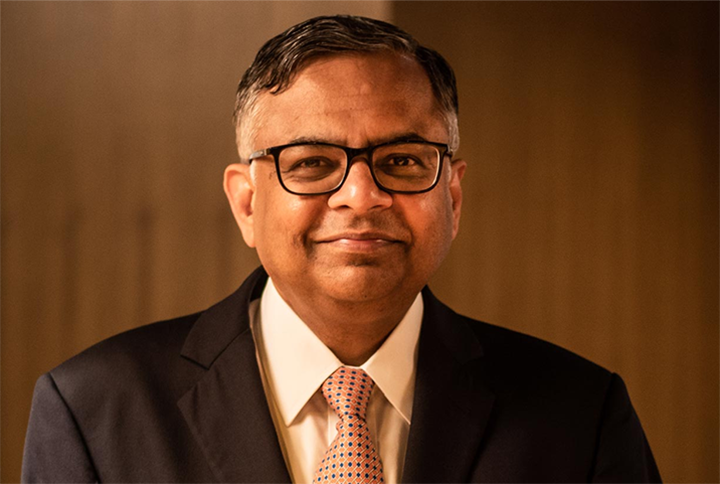
Photo courtesy: Tata Sons website
Chandrasekaran leaves neither as a failure nor a clear winner. He repaired the Tata machine but made it more capital-intensive. His successor inherits stronger assets and revived brands, but also bets such as Air India that must prove scale can deliver returns
N Chandrasekaran leaves Tata Sons after a decade that repaired old industrial businesses, rebuilt the balance sheet and revived passenger vehicles—but also left expensive new bets, a faltering TCS, weak stock-market performance and the Air India turnaround still years from completion.
When Chandrasekaran—or Chandra as he is popularly known—became Tata Sons chairman in 2017, he inherited a familiar problem. Like Ratan Tata and Cyrus Mistry in their final years, he faced slowing earnings and disappointing share prices. His dilemma is harder: listed performance is muted while unlisted subsidiaries, many created or expanded under his watch, are losing money.
He nevertheless leaves behind repairs. Tata Motors’ domestic passenger-vehicle business became a success that eluded both predecessors. Indian Hotels, Tata Steel and Tata Consumer—formerly Tata Global Beverages—also returned to growth. Listed companies’ gross debt-to-equity ratio fell to 0.7 in FY26 from 1.1 in FY17, while return on net worth rose to 19 per cent from 16.2 per cent in FY17 and 18.6 per cent in FY12.

But momentum has cooled. Combined net sales of listed Tata companies, excluding Tata Capital, rose only 3.9 per cent year-on-year in FY26, after 2.5 per cent in FY25. Adjusted net profit rose 1.2 per cent, following a 1.1 per cent decline in FY25. Sales reached Rs 11.8 lakh crore and adjusted profit Rs 90,698.4 crore, against Rs 89,617.6 crore in FY25 and Rs 90,590.5 crore in FY24.
The market has been less forgiving. Tata companies’ combined market capitalisation fell 16.9 per cent in FY26, versus a 3.7 per cent Nifty decline, after an 8.1 per cent fall in FY25 against a 4.4 per cent Nifty rise. It was the first consecutive annual decline since FY11. Tata mcap fell from a record Rs 29.88 lakh crore in March 2024 to Rs 22.82 lakh crore in March 2026, before recovering to Rs 25.5 lakh crore on August 12. Nifty mcap rose from Rs 179.1 lakh crore to Rs 179.9 lakh crore and then Rs 198.9 lakh crore. Since March 2016, Tata companies’ mcap has risen 233.9 per cent, versus 276.3 per cent for the Nifty. The Tatas outperformed from FY20 to FY24, but have lagged since.
Earlier chairs offer a revealing comparison. In FY12, Tata adjusted profit fell 3 per cent to Rs 26,496.7 crore, but sales jumped 24.5 per cent to Rs 4.32 lakh crore; mcap fell 3.6 per cent to Rs 4.4 trillion, against a 4 per cent Nifty decline to Rs 35.2 lakh crore. In FY17, profit fell 5 per cent to Rs 35,292 crore while sales rose just 2.1 per cent to Rs 5.93 lakh crore.

More worrying is strain on the group’s cash engine. TCS adjusted profit grew 8.3 per cent in FY26, but its mcap plunged 34.6 per cent, its weakest annual performance in at least 15 years. Its dividend payout fell 12.7 per cent, after a 3.9 per cent reduction in FY25, threatening Tata Sons’ FY27 revenue and profits. Chandrasekaran’s pay, including salary and commission, compounded 14.1 per cent from Rs 55.1 crore in FY18 to Rs 158.7 crore in FY26. Tata Sons’ consolidated adjusted profit fell 11.9 per cent to Rs 17,923 crore from rs 20,344 crore, even as listed-company profit grew 9.2 per cent annually from Rs 44,786.5 crore to Rs 90,698 crore. Group mcap grew 11.9 per cent annually in the same period.
Air India captures the unfinished side of the legacy. Tata took control in January 2022, inherited ageing aircraft, obsolete technology and organisational problems, and launched Vihaan.AI in September 2022. Four years on, he says the turnaround may take five to ten years. Losses have reached Rs 47,821 crore. Supply-chain shortages, delayed deliveries, slow retrofits, legacy systems, culture and talent have stretched the timetable.
The airline merged with Vistara in November 2024, while AIX Connect was folded into Air India Express. Then came shocks: Pakistan’s 2025 airspace closure raised costs; the June 12, 2025 AI-171 crash killed 260 people; DGCA cited crew-rostering failures and issued notices over 29 violations; in November an A320 flew eight commercial flights with an expired Airworthiness Review Certificate, earning a Rs 1-crore penalty. This year, conflict involving Israel, the US and Iran again forced curtailments as fuel costs rose and the rupee weakened. CEO Campbell Wilson is leaving in 2026, while former Ethiopian Airlines chief Tewolde Gebremariam is due to take over.

Tata Steel offers a more hopeful template. Under Chandrasekaran, India’s capacity more than doubled: the second Kalinganagar phase took capacity from 3 mt to 8 mt in FY26. FY26 India Ebitda was Rs 34,272 crore; Netherlands Ebitda rose to €267 million and UK losses nearly halved to £217 million. The Port Talbot electric-arc furnace, under construction after work began in July 2025, is meant to put the UK business on a sustainable footing. Yet the Corus legacy endures: the £6.2 billion 2007 acquisition, UK capacity falling from 10 mt to 3.2 mt.
Chandrasekaran therefore departs neither as a failure nor as a clean winner. Ratan Tata left with growth slowing; Mistry was dismissed amid a sharper downturn. Chandrasekaran repaired much of the old Tata machine, but also built a more capital-hungry one. His successor inherits both the prize and the bill: stronger Indian industrial assets, a healthier balance sheet and revived brands—and a portfolio whose newest bets, especially Air India, must still prove that scale can become returns.