Thursday, 17 Sep, 2026

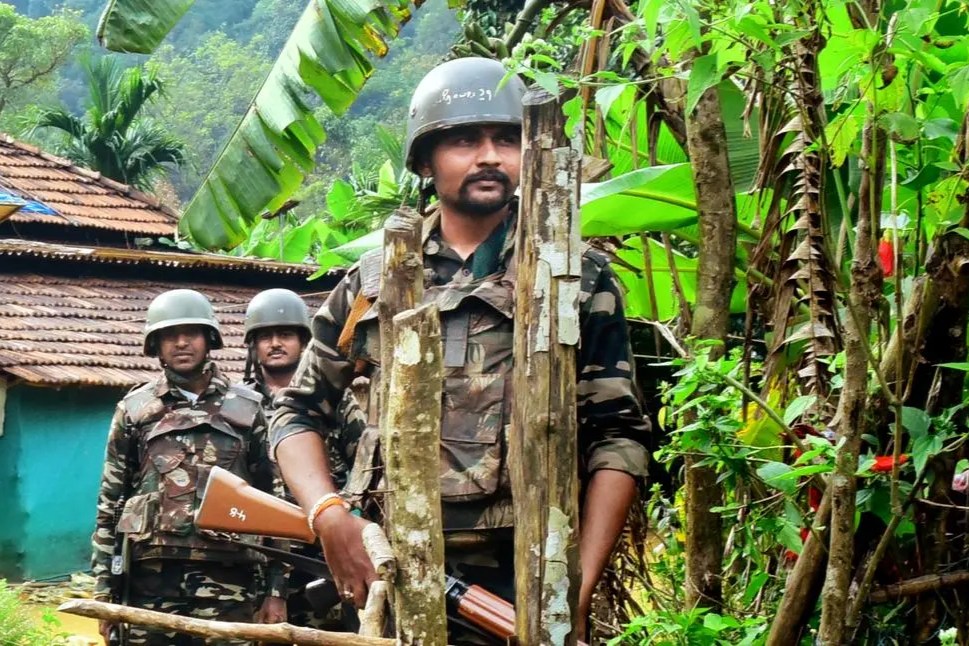
Over 2,200 Naxalites, including a number of senior officials, have turned themselves in in Chhattisgarh over the past 23 months, according to statewide statistics. Image Source: Frontline
According to police officials, the current operation was launched after specific intelligence inputs suggested the presence of a large Maoist contingent in the hilly and densely forested areas of north-western Bijapur.
At least two Maoists were killed on Saturday morning in a fierce encounter with security forces in the dense forested terrain of Chhattisgarh’s Bijapur district. Senior police officials confirmed that exchanges of gunfire between the two sides were continuing intermittently in the north-western part of the district, indicating that the operation remains active. The ongoing operation is focused on tracking down Papa Rao, one of the most senior surviving leaders of the CPI (Maoist) in the Bastar region. Rao is a key member of the Dandakaranya Special Zonal Committee (DKSZC), the highest state-level decision-making body of the banned outfit. He also serves as secretary of the South Bastar Zonal Bureau Committee and heads the West Bastar Division Committee, making him a crucial operational and strategic figure within the Maoist hierarchy.
Security agencies have been pursuing Rao intensively since November last year, when his wife, Urmila (40), and Kanna alias Buchanna (35) were among six Maoists killed in an encounter inside Indravati National Park, also in Bijapur district. Buchanna was believed to be a critical conduit between the armed Maoist cadre and their urban support network. Papa Rao himself has long been on the radar of security forces for his alleged role in several major attacks, including the deadly 2010 ambush in Dantewada that left 76 security personnel dead.
According to police officials, the current operation was launched after specific intelligence inputs suggested the presence of a large Maoist contingent in the hilly and densely forested areas of north-western Bijapur. Acting on this information, a joint force comprising personnel from the District Reserve Guard (DRG) and other security units was deployed to carry out a coordinated search and cordon operation.
Inspector General of Police (Bastar Range) Sundarraj P said that the forces encountered armed Maoists soon after the search began. “A joint team initiated a search operation in the forested hills of north-western Bijapur. Since this morning, there has been a continuous but intermittent exchange of fire between the security forces and the Maoists,” he said. Officials added that due to the operation still being underway and the challenging terrain marked by thick forests, steep hills, and limited accessibility details such as the precise location of the encounter and the number of personnel involved are being withheld for operational and troop safety reasons.
“The operation is still in progress, and the safety of our jawans is our foremost priority,” the IG said. “A comprehensive briefing on the outcome of the encounter, including casualties and recoveries, will be shared once all teams safely return to their base camps.” The encounter underscores the continued intensity of counter-insurgency operations in the Bastar region, even as security forces seek to neutralise remaining top Maoist leadership and dismantle their organisational structures.
Over 2,200 Naxalites, including a number of senior officials, have turned themselves in in Chhattisgarh over the past 23 months, according to statewide statistics. This indicates a steady decline in the insurgent movement and a slow transition to the mainstream. In recent years, however, the Indian government’s comprehensive counter-LWE approach, blending intensified security operations with developmental initiatives and community outreach has delivered measurable success. Maoist influence has been significantly curbed, violence levels have dropped sharply, and several previously affected districts are now on a path toward reintegration and progress.
The central government has set an ambitious goal of eradicating Naxalism entirely by March 31, 2026. Officials view the insurgency as a major impediment to development, particularly in tribal and remote areas, where it hampers access to essential services like education, healthcare, roads, banking, and postal facilities.
| Decline in Naxal Violence over the last decade | |||
|
Indicators |
2004-14 |
2014-24 |
Decrease |
|
Violent Incidents |
16,463 |
7,744 |
53% |
|
Security Personnel Deaths |
1,851 |
509 |
73% |
|
Civilian Deaths |
4,766 |
1,495 |
70% |
Source: Ministry of Home Affairs, Government of India
In a major push toward the Modi government’s goal of eliminating Naxalism, the list of districts most severely impacted by Left Wing Extremism has been reduced from six to three. At present, only Bijapur, Sukma, and Narayanpur in Chhattisgarh remain in the category of most-affected districts. The number of districts classified as LWE-affected has also seen a significant drop from 18 to just 11, indicating a continued decline in extremist influence across the country.
While speaking at the valedictory session of Bharat Manthan 2025, Amit Shah, Union Minister of Home Affairs and Minister of Cooperation said that between 2014 and 2024, nearly 12,000 kilometers of roads were built in states affected by Left-Wing Extremism, with funding sanctioned for an additional 17,500 roads. During this period, 5,000 mobile towers were also installed at a cost of ₹6,300 crore. Infrastructure and service expansion has continued with the opening of 1,060 bank branches, installation of 937 ATMs, appointment of 37,850 banking correspondents, establishment of 5,899 post offices, creation of 850 schools, and setting up of 186 modern health centers.
He further highlighted that under the Niyad Nellanar initiative, the Chhattisgarh government is facilitating the approval of Ayushman Bharat health cards, Aadhaar IDs, voter cards, and the construction of schools, ration shops, and Anganwadi centers.
Security forces have recorded significant gains against Left Wing Extremism in recent years, with 2025 marking an especially decisive phase so far. Since the beginning of this year, 317 Naxals have been neutralised, 862 arrested, and as many as 1,973 cadres have laid down their arms and surrendered, reflecting sustained operational pressure as well as the impact of surrender and rehabilitation policies.
The momentum builds on the outcomes of 2024, when security agencies neutralised 290 Naxals, arrested 1,090 operatives, and facilitated the surrender of 881 individuals. Taken together, these figures point to a steady erosion of both the armed strength and organisational depth of the CPI (Maoist).
Particularly notable has been the targeting of senior leadership. A total of 28 top Naxal leaders have been neutralised over the past two years, including one Central Committee member in 2024 and five Central Committee members in 2025. The elimination of such high-ranking figures has dealt a severe blow to the group’s command-and-control structure, disrupting strategic planning, inter-zonal coordination, and cadre morale.
Several major operations and surrender events underscore this trend. Operation Black Forest resulted in the elimination of 27 hardcore Naxals, dealing a direct hit to armed formations in core Maoist areas. In Bijapur alone, 24 Maoists surrendered on 23 May 2025, signalling weakening cohesion within local units. This was followed by a large-scale wave of surrenders in October 2025, when 258 Naxals surrendered across Chhattisgarh (197) and Maharashtra (61), including 10 senior-level cadres—an outcome seen as particularly significant by security planners.
Beyond kinetic operations, the Central Government has moved decisively to choke the financial lifelines of the Maoist movement. A dedicated vertical within the National Investigation Agency (NIA) has been established to track and dismantle Naxal funding networks, leading to the seizure of assets worth over ₹40 crore. Complementing this effort, state agencies have seized assets exceeding ₹40 crore, while the Enforcement Directorate has attached properties valued at around ₹12 crore under anti-money laundering provisions. These actions have severely constrained the ability of the outfit to sustain logistics, procure weapons, and support underground networks.
At the same time, coordinated action against urban Naxal networks has inflicted significant moral and psychological damage. Crackdowns on front organisations, overground workers, and propaganda channels have tightened state control over the information and influence operations traditionally used to sustain ideological support, recruitment, and international narratives.
Collectively, the combination of intensified ground operations, leadership decapitation, financial disruption, and information warfare has placed the Maoist movement under unprecedented pressure, significantly narrowing its operational space across central India.