Thursday, 17 Sep, 2026

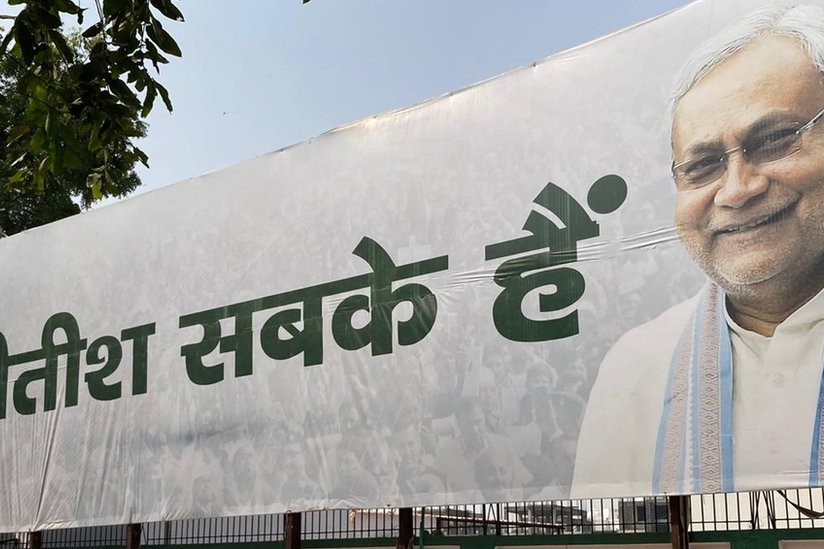
Source of the image is "BBC"
For nearly two decades, Bihar’s politics revolved around Nitish Kumar’s continued presence in power. His departure from the Chief Minister’s post now signals the beginning of a new phase in the state’s political dynamics.
On March 5, 2026, Nitish Kumar filed his Rajya Sabha nomination with Union Home Minister Amit Shah present by his side. Less than four months earlier, in November 2025, he had taken oath as Bihar's Chief Minister for a record tenth time. His decision to vacate the post and move to the upper house of parliament is being widely seen as a turning point in Bihar politics.
Kumar's political career began in 1974 when he joined Jayaprakash Narayan's Sampoorna Kranti movement during the anti-emergency agitation. He was first elected as an MLA from Harnaut in Nalanda district in 1985, and won his first Lok Sabha seat from the Barh constituency in 1989. By 1990, he had been appointed Minister of State in V.P. Singh's government. In the early 1990s, he was an influential figure within the Janata Dal in Bihar, playing a role in helping Lalu Prasad consolidate his position as Chief Minister. By 1994, the two had fallen out. Kumar organised a Kurmi Chetna Maharally at Gandhi Maidan in Patna, broke away from the Janata Dal, and co-founded the Samata Party alongside George Fernandes. The Samata Party allied with the BJP in 1996, and Kumar went on to serve as Railway Minister in Prime Minister Atal Bihari Vajpayee's government from 1998 to 2004.
His first stint as Chief Minister came in March 2000, after the Bihar assembly elections produced a hung house. He was sworn in on March 3 but resigned on March 10 after failing to prove his majority. He returned to the post in November 2005 with a stable majority as part of the NDA, and between 2005 and 2026, took oath as Chief Minister ten times in total. For nine months between May 2014 and February 2015, Jitan Ram Manjhi served as Chief Minister in his place, but Kumar returned after Manjhi's resignation.
What made Kumar's long hold on power notable was not the seat count his party consistently delivered, but his ability to remain politically indispensable regardless of electoral outcomes. Among his supporters, he earned the title of "Sushasan Babu", a reference to his governance record, particularly in the early years of his tenure when Bihar saw improvements in law and order, road infrastructure, and administrative functioning. Among his critics, he became "Paltu Ram", a pointed reference to his repeated switching of alliances.

The election data makes the alliance shifts visible. In 2005, the JD(U) won 88 seats, and the BJP won 55. By 2010, the JD(U) had climbed to 115 seats- its highest ever tally- while the BJP won 91. Together, the NDA was dominant. In 2013, Kumar pulled out of the NDA after Narendra Modi was named the BJP's prime ministerial candidate. In the 2015 elections, he allied instead with Lalu Prasad's RJD and the Congress to form the Mahagathbandhan. RJD won 80 seats, JD(U) 71, and Congress 27, while the BJP won 53, contesting largely on its own.
By 2017, Kumar had broken with the Mahagathbandhan and returned to the NDA, citing corruption cases involving Lalu Prasad's family. In the 2020 elections, the balance within the alliance shifted visibly; the BJP won 74 seats to JD(U)'s 43. Kumar continued as Chief Minister, but the BJP had become the larger partner. In 2022, he left the NDA again and revived the Mahagathbandhan with the RJD and Congress. In 2024, he returned to the NDA for the third time.
Through all of this, the Chief Minister's post stayed with him. This is what makes his political record distinct. Even in 2020, when his party won just 43 seats against the BJP's 74, Kumar retained the top job. His value to the NDA lay not just in his seat tally but in the social coalition he represented, a combination of lower OBCs and Dalits who had been largely outside Lalu Prasad's Muslim-Yadav political arrangement. Kumar's JD(U) held the social justice base of the alliance while the BJP consolidated upper-caste support. Neither party, for a long time, could afford to contest without the other.
In the October 2025 assembly elections, the NDA won 202 of 243 seats. The BJP won 89, JD(U) won 85, LJP (Ram Vilas) won 19, Rashtriya Lok Morcha won four, and Hindustani Awam Morcha won five. Kumar was sworn in as Chief Minister for the tenth time in November 2025. But the gap between the two main partners had narrowed to just four seats, and the BJP had now been the larger party within the alliance for two consecutive elections.
The discussions that led to Kumar's Rajya Sabha move reportedly began about a month before the announcement, initially around accommodating his son Nishant, who has been building a political profile and is seen within the JD(U) as a potential unifying figure for the party. Five Rajya Sabha seats are falling vacant in Bihar, and the NDA has sufficient numbers in the assembly to fill four of them comfortably.
In a state where caste has historically dominated electoral outcomes and voting patterns have largely followed rigid social alignments, Nitish Kumar carved out a different kind of political support base: women. Through initiatives such as Jeevika Didi and the introduction of 50% reservation for women in Panchayati Raj institutions and local bodies, he built a loyalty among women voters that cut across caste groups, giving him an electoral base that was harder to poach or replicate. It was perhaps the most distinctive element of his electoral arithmetic.
At 75, with his health visibly declining in recent years, Kumar’s stepping down had been anticipated within political circles for some time. Yet the manner of his exit, moving to the Rajya Sabha rather than withdrawing from active politics, suggests that his political relevance may not be entirely over, even if his long tenure as Bihar’s Chief Minister is. His departure also opens the door for the BJP to attempt to install its first-ever Chief Minister in Bihar, a state with over 74 million voters and one of the few large states where the party has not governed independently.