Monday, 21 Sep, 2026

Source of the image: Sansad TV.
With the passage of the Prevention of Insults to National Honour (Amendment) Bill, 2026, Vande Mataram now enjoys statutory protection alongside India's other national symbols, reviving questions about the limits of criminal law in regulating patriotic expression.
Parliament has passed the Prevention of Insults to National Honour (Amendment) Bill, 2026, bringing the national song under the ambit of the 1971 Act that already protects the National Anthem, the National Flag and the Constitution. Under the amended law, anyone who intentionally prevents or disrupts the singing of Vande Mataram can face imprisonment of up to three years, a fine, or both. While the government has projected the move as a tribute to the song's role in India's freedom movement, the amendment has also revived questions over the role of criminal law in enforcing patriotic expression and whether the existing legal framework warranted such an expansion.
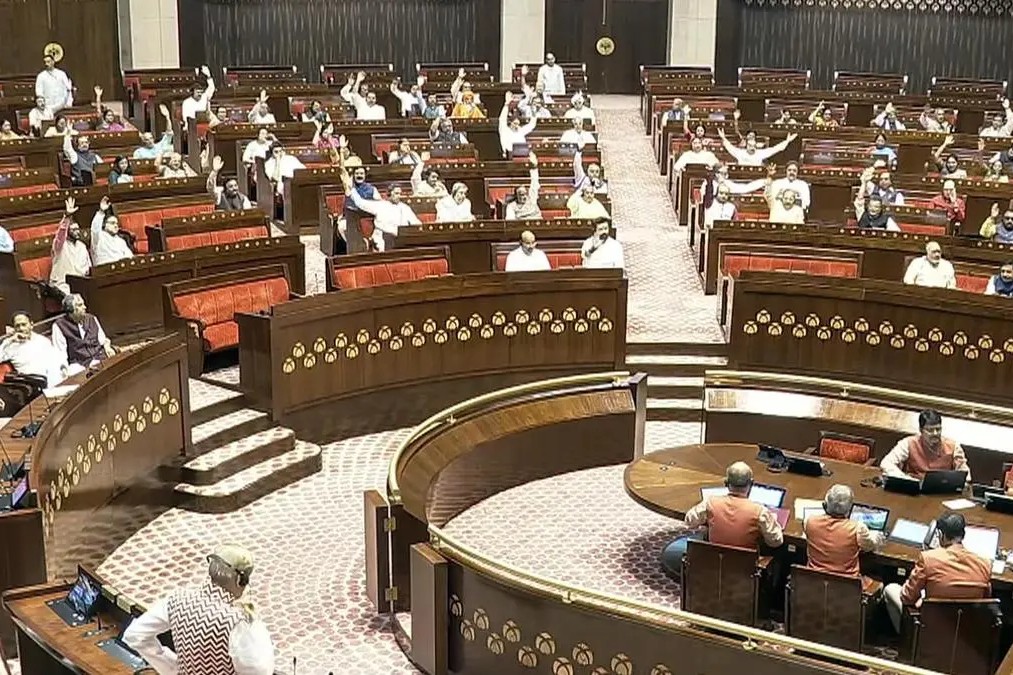
The amendment was passed amid noisy proceedings in both Houses of Parliament, with the Opposition protesting the Bill. Despite the disruptions, the government defended the legislation as a long-overdue step to give Vande Mataram the same statutory protection available to other national symbols. Minister of State for Home Affairs Nityanand Rai argued that the amendment was not merely a legal exercise but an acknowledgement of the song's historical contribution to India's freedom struggle. Referring to Bankim Chandra Chatterjee, who composed Vande Mataram, Rai said the song had inspired generations of freedom fighters and occupied a unique place in India's nationalist movement. He also cited Dr Rajendra Prasad's remarks in the Constituent Assembly in January 1950 that Vande Mataram should enjoy the same honour as Jana Gana Mana, arguing that the amendment only gives legal backing to that sentiment.
Beyond the political rhetoric, however, the amendment raises a practical question: how frequently has the existing law been invoked, and does the available data point to a growing problem? Data from the National Crime Records Bureau (NCRB) suggests that offences under the Prevention of Insults to National Honour Act have remained relatively limited over the past decade. Between 2014 and 2024, police registered 699 cases under the Act, averaging about 64 cases each year. The highest number of cases, 87, was reported in 2022, while 57 cases were registered in 2024. Relative to India's population and overall crime figures, these offences account for only a small fraction of criminal cases recorded annually.
The more striking trend lies not in the number of cases but in what happens after they are registered. NCRB data shows that investigations and trials have become increasingly delayed over the years. By the end of 2024, 53 cases under the Act were still under police investigation, while another 358 cases were pending trial in courts, more than four times the pendency recorded in 2014. Police chargesheet rates have also declined, falling from 53.6 per cent in 2014 to 36.5 per cent in 2024. These figures indicate that even under the existing law, the criminal justice system has struggled to dispose of cases efficiently.
The gap between arrests and convictions is equally significant. Between 2014 and 2024, police arrested 1,102 people for offences under the Act and filed chargesheets against 962 individuals. Yet only 60 people were convicted during this period, while 153 were acquitted or discharged. In every year covered by the NCRB data, acquittals outnumbered convictions, and the overall pendency rate remained above 90 per cent for almost the entire decade. Rather than pointing to widespread violations of national symbols, the data paints a picture of prolonged investigations, delayed trials and relatively few successful prosecutions.

These numbers have shaped much of the debate around the amendment. Supporters argue that the frequency of violations is less important than the symbolic value of protecting a national emblem associated with India's independence movement. Critics, however, question whether expanding the scope of a law that already records low conviction rates and high pendency addresses a genuine enforcement gap. They contend that before creating additional criminal liability, greater attention should be paid to improving the investigation and disposal of cases already covered under the existing legislation.
While the government projected the amendment as a measure to protect a national symbol, the debate in Parliament quickly expanded beyond the text of the legislation. Opposition parties questioned both the need for the amendment and the message it sought to convey. Some members argued that respect for national symbols cannot be legislated and warned against using criminal law to define patriotism. Others pointed out that Vande Mataram has historically occupied a unique position in India's constitutional journey. Although the Constituent Assembly accorded it equal honour with the National Anthem, only its first two stanzas came to be officially recognised for public use because later verses, which invoke the motherland in the form of a goddess, had drawn objections from some sections even before Independence. Critics argued that the amendment ignores this historical context and risks reopening debates that had been consciously settled during the framing of the Constitution.
The legislation has also attracted criticism outside Parliament. The All India Muslim Personal Law Board (AIMPLB) described the amendment as inconsistent with the constitutional guarantees of religious freedom and freedom of expression. In a statement issued after the Bill was passed, the organisation argued that compelling citizens to participate in the singing of Vande Mataram could violate the beliefs of communities that object to certain portions of the song on religious grounds. It maintained that patriotism should not be measured by participation in a particular song or slogan and that constitutional rights protect an individual's freedom of conscience as much as the freedom to express national pride.
To support its position, the AIMPLB referred to the Supreme Court's judgment in Bijoe Emmanuel v. State of Kerala (1986), one of the most significant rulings on the relationship between patriotism and fundamental rights. In that case, the Court held that students belonging to the Jehovah's Witness faith could not be compelled to sing the National Anthem if doing so conflicted with their religious beliefs, provided they stood respectfully while it was being sung. The judgment established that respectful non-participation does not automatically amount to disrespect and that freedom of expression also includes the right to remain silent in certain circumstances. Although the present amendment concerns the national song rather than the National Anthem, the ruling has once again become central to the legal debate over whether the state can mandate specific expressions of patriotism without infringing constitutional freedoms.
The amendment therefore sits at the intersection of two competing ideas. On the one hand, the government's argument is that Vande Mataram deserves stronger legal protection because of its historic role in India's freedom struggle and its symbolic importance to the country's national identity. On the other hand is the view that patriotism derives its strength from voluntary respect rather than legal compulsion, and that expanding criminal law into questions of symbolic expression should be approached with caution. Both sides draw legitimacy from history, but they differ sharply on the role the state should play in enforcing that history through penal legislation.